A Quarter Past Twelve Clip Art 9 20 Digital
DIGITAL 2022: Another YEAR OF BUMPER GROWTH
 News
News
12½ trillion hours spent online, a new milestone in internet adoption, and new records for social media useastward. Kepios founder Simon Kemp takes usa through the key headlines featured in Digital 2022.
If y'all expected digital to return to "business as usual" in 2022, you may desire to reset those expectations.
Our new Digital 2022 Global Overview Report – published in partnership betwixt Nosotros Are Social and Hootsuite – reveals that well-nigh of the connected globe continues to grow faster than it did earlier the pandemic.
Big stories in this year's written report include:
- Double-digit growth in social media users
- Big gains for YouTube, Instagram, and TikTok
- New insights into the globe's social media preferences
- The rise of social commerce
- Pregnant increases in the cost of social media ads
- Some uncomfortable truths about advertising
We've likewise got a wait dorsum at the kickoff ten years of the Global Digital Reports series.
At almost eight,000 words, this article's a flake of a creature, and then get yourself comfortable, and ready for a full-on feast of facts and figures.
Best-in-grade data
As always, I'd like to showtime by saying a very large give thanks y'all to the world-grade data partners who've fabricated this year'due south reports possible, especially:
- GWI
- Statista
- GSMA Intelligence
- App Annie
- Semrush
- SimilarWeb
- Locowise
- Skai
Of import notes
Only before we get into the numbers, I'd like to encourage all readers to review our detailed notes on data, to empathize how changes in information sources and methodologies may impact this year's numbers.
Alerts to highlight include:
- Cyberspace users: delays in reporting due to COVID-nineteen may hateful that figures for "yr-on-year change" represent change over periods of more one year.
- Social media users: big changes in platform reporting hateful that various numbers included in this yr'south reports are not directly comparable with figures for the same information points featured in our previous reports. Where we've been able to calculate representative growth figures, we've included those growth figures within this year's reports, but where we haven't included growth figures, it's likely that whatever comparisons with historical data volition deliver wrong values. Equally a result, delight avoid comparing social media users and advertising audience figures in this twelvemonth's reports with figures published in our previous reports.
But without further ado, let's dive into the data…
Peak ten takeaways
I'd recommend starting with this video, which offers a handy summary of this year'southward essential headlines and trends.
Once you lot've finished watching that, read on below for the full study.
Total report
You'll find our Digital 2022 Global Overview Report in the SlideShare embed beneath (click here if that's not working for you), but read on beneath for my complete assay of this yr's top findings.
Essential headlines
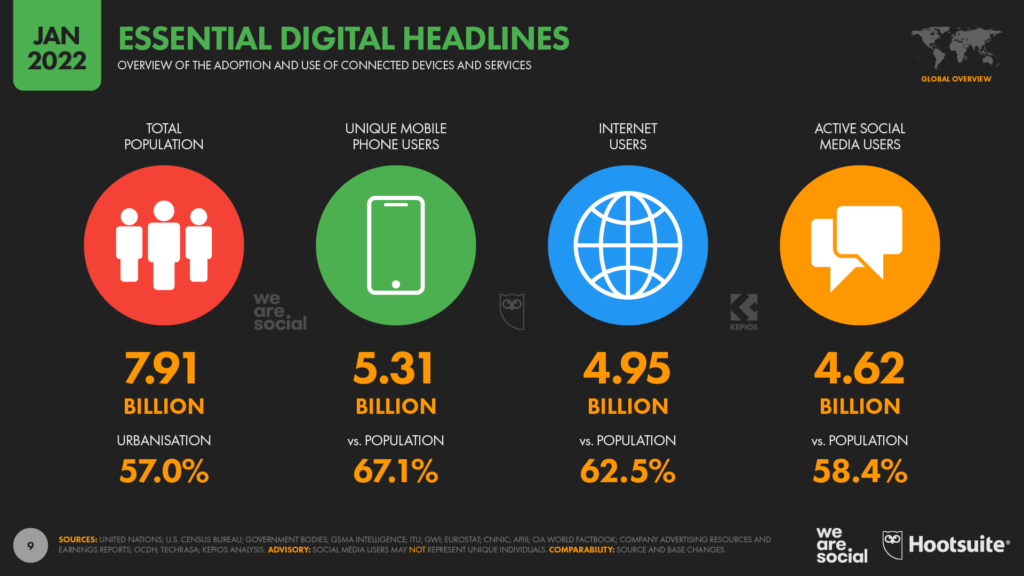
Here are the key figures y'all need to understand the 'state of digital' today:
- Global population: The world'southward population stands at 7.91 billion in January 2022, with the almanac growth rate of ane.0 pct suggesting that this figure will attain 8 billion sometime in mid-2023. Well over one-half (57.0 per centum) of the world's population now lives in urban areas.
- Global mobile users: More than 2-thirds (67.1 percent) of the world'southward population at present uses a mobile phone, with unique users reaching 5.31 billion by the start of 2022. The global total has grown by 1.8 percent over the past yr, with 95 1000000 new mobile users since this time terminal year.
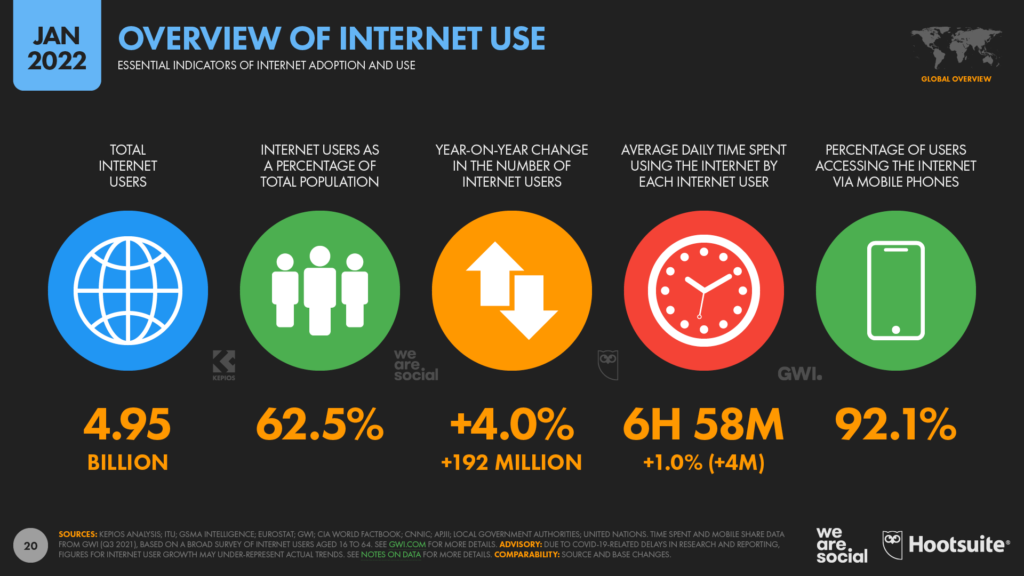
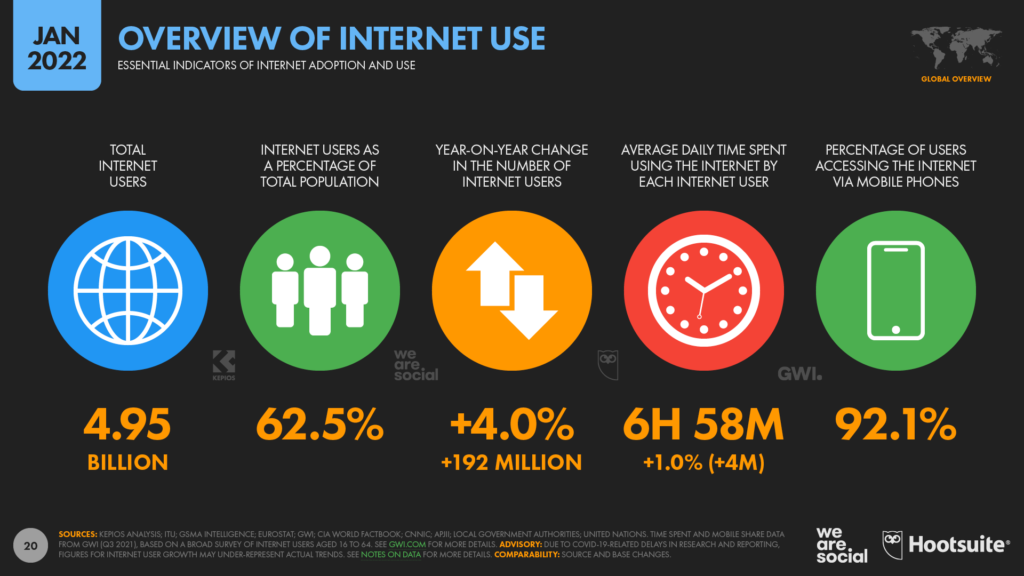
- Global cyberspace users: Global internet users have climbed to 4.95 billion at the starting time of 2022, with internet penetration now standing at 62.5 percentage of the globe's full population. Information prove that cyberspace users have grown by 192 million (+4.0 percentage) over the by year, merely ongoing restrictions to inquiry and reporting due to COVID-19 mean that actual growth trends may exist considerably higher than these figures suggest.
- Global social media users: There are 4.62 billion social media users around the earth in January 2022. This figure is equal to 58.4 per centum of the globe's full population, although information technology's worth noting that social media "users" may non represent unique individuals (learn why). Global social media users have grown by more than than 10 per centum over the past 12 months, with 424 one thousand thousand new users starting their social media journey during 2021.
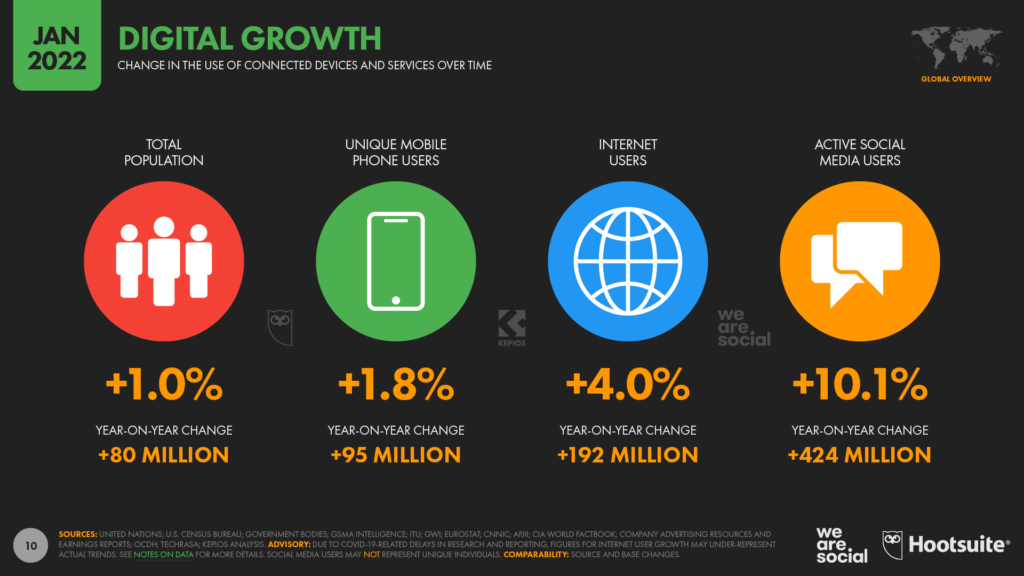
These numbers provide valuable context for digital adoption and growth, simply in society to make sense of what people are actually doing online, we need to dig deeper into the numbers.
And the expert news is that we've got lots of numbers to dig into…
A decade of digital growth
This year marks the tenth ceremony of the first global written report in our Global Digital Reports series, so we tin now look back over a full decade of digital information.
If y'all'd like to indulge in a bit of nostalgia, you can notice our first Global Overview Report here, while all subsequent reports in the series are too available in our costless library.
You can as well detect my comprehensive analysis of key trends over the past decade in this in-depth article.
Note that considerably more than data is available today than it was at the time nosotros produced many of our before reports though, so some of the figures I'll encompass below may not friction match those that we published in previous reports.
Cyberspace user growth
Kepios analysis reveals that net users have more than than doubled over the past 10 years, climbing from two.xviii billion at the first of 2012, to four.95 billion at the start of 2022.
That results in a compound annual growth rate (CAGR) of 8.half-dozen percent for the past decade as a whole, but – as you tin can run into in the nautical chart below – almanac growth rates accept fluctuated meaningfully from one year to some other.
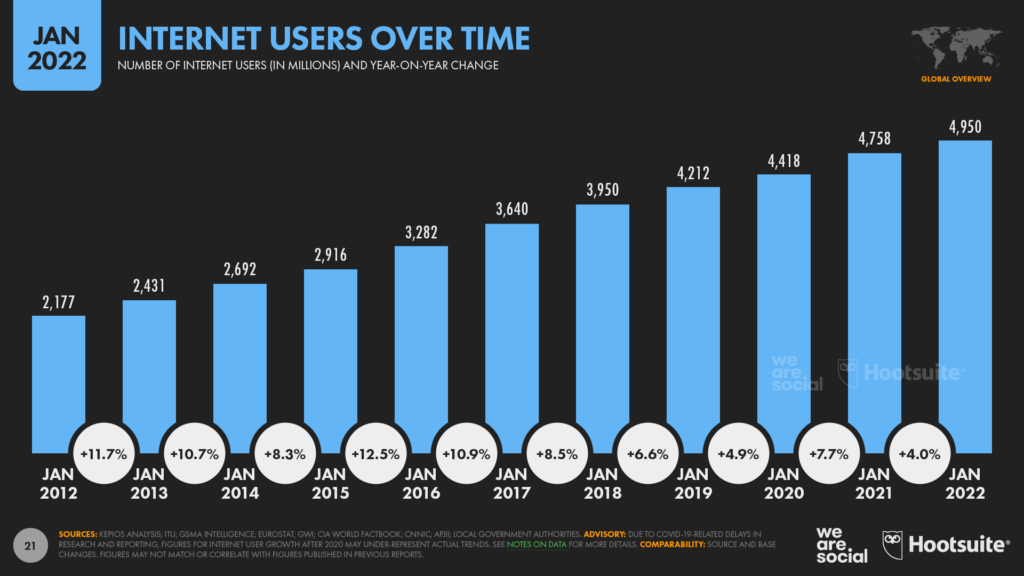
The latest information advise that internet users grew by 192 million over the past 12 months, resulting in almanac growth of just four.0 percent in 2021.
However, we strongly doubtable that this lower growth figure is more likely the consequence of challenges associated with collecting and reporting information during the ongoing COVID-19 pandemic, and that these numbers don't reverberate the actual growth in net users over the past year.
As a effect, there's a very good chance that we'll written report college numbers for growth between 2021 and 2022 in one case newer information becomes available.
Social media user growth
Meanwhile, social media users take seen even faster growth than cyberspace users over the past decade.
Today's total of 4.62 billion social media users is 3.1 times college than the 1.48 billion figure nosotros published in 2012, and means that social media users accept grown at a CAGR of 12 percent over the by decade.
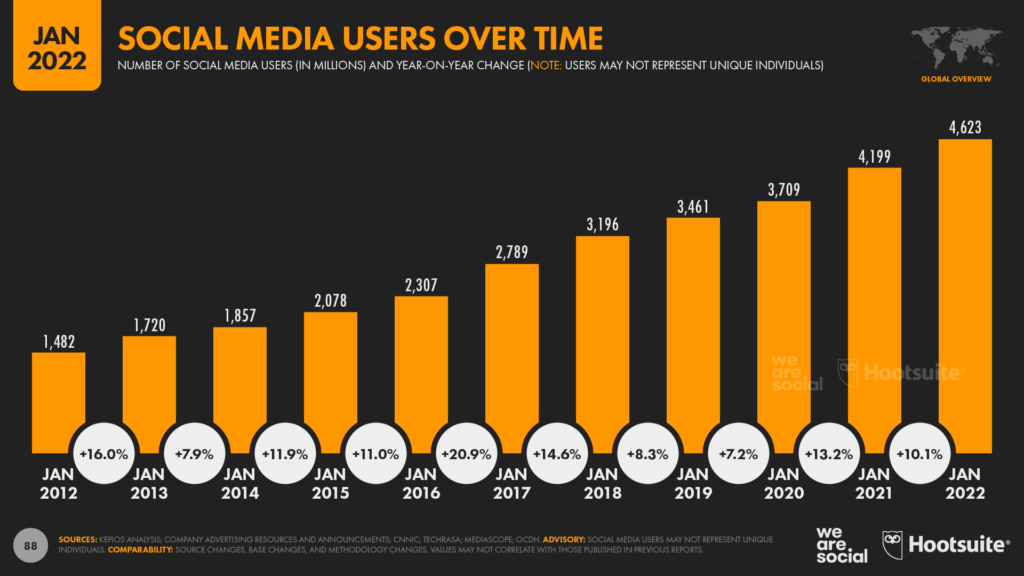
Social media user growth has continued at a double-digit rate of ten.i percent over the past 12 months too, but I confess I'm surprised that the growth rate between 2021 and 2022 has remained to a higher place pre-pandemic levels.
For context, the latest information indicate that 424 million users started their social media journeying over the past yr, equating to an average of more than i million new users per 24-hour interval, or roughly 13½ new users every unmarried second.
However, anyone who had been wavering about joining social media earlier the pandemic struck would have been virtually probable to join during the early on days of lockdown in 2020, and so I'thou hesitant to attribute whatsoever meaningful share of growth over the most recent 12 months to some kind of "COVID effect".
Moreover, with social media users now equating to 58.iv percent of the world'southward full population, we should await to see growth rates start to decelerate over the next few years, and this may well exist the last time that we report double-digit annual growth in social media users.
The good news is that we should meet social media users reach the equivalent of 60 per centum of the global population sometime in 2022 though, so even if growth rates do subside, the overall achieve potential of social media should still offer plenty to get excited about.
Dig deeper: click hither to learn more about what time to come digital growth rates might wait like.
Fifty-fifty fewer offline, but big challenges remain
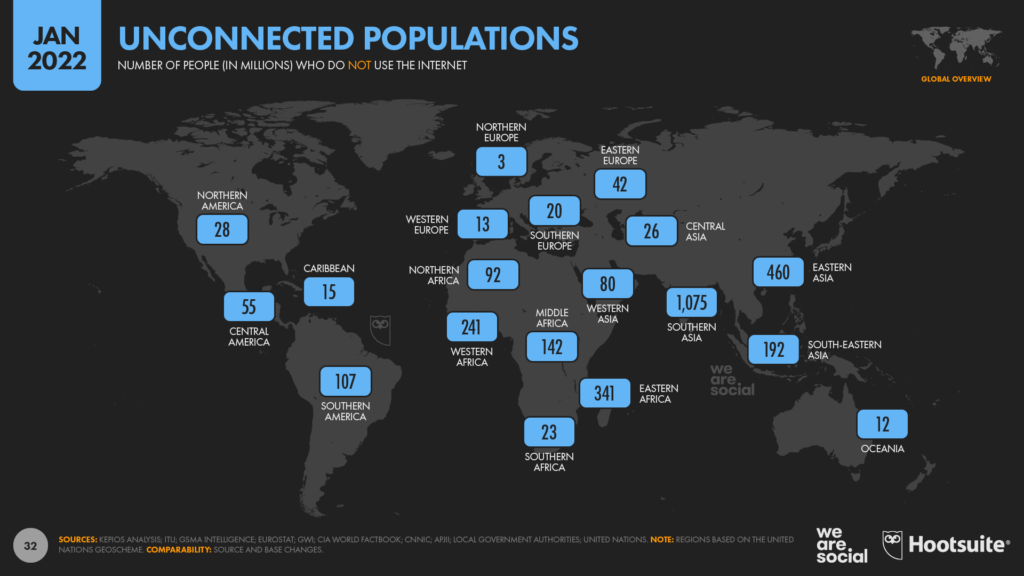
Data reveal that the number of people who remain "unconnected" to the internet has now dropped beneath three billion for the first time.
This marks a significant milestone in the world's journeying towards equal digital access, and has particular relevance as the function of connected devices has moved from luxury to lifeline, particularly during the COVID-19 pandemic.
However, the latest information also reveal that at that place's plenty more piece of work to do.
More than 1 billion people remain offline across Southern Asia, while most 840 meg people are all the same to come online across Africa.
Meanwhile, despite bookkeeping for roughly 1 in 5 of the world's connected population, China is even so home to more than 400 million of the earth's "unconnected".
For context, the median historic period of the population plays an important part in shaping adoption levels across many parts of Africa, with more than half of the populations of several countries in the region still beneath the age of xx.
Yet, basic infrastructure challenges remain an important consideration too.
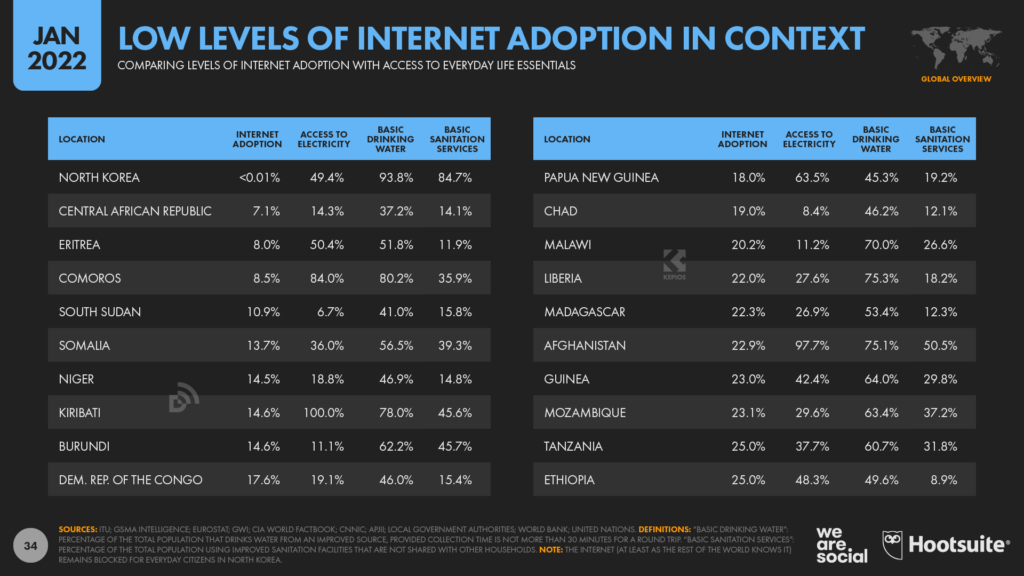
For example, in the Central African Republic – where internet adoption remains stubbornly depression – barely 1 in 7 people currently has admission to electricity, and the vast majority of people still don't have access to basic sanitation either.
Furthermore, the excellent State of Mobile Internet Connectivity 2021 report from GSMA Intelligence reveals that one in 4 people across lower- and middle-income countries is notwithstanding unaware of the beingness of mobile internet.
In other words, hundreds of millions of people around the globe may even so non even know that the internet exists.
And then, while the United nations may have designated internet access a "basic human being correct", there's still a long way to go to ensure that everyone has equal access to what is arguably the most of import innovation of our age.
Related: click here to learn more than about the globe'due south top motivations for going online.
Social media favourites
When it comes to the world's "favourite" social media platforms, GWI's latest data reveals that Instagram has now overtaken Facebook to merits second place in the worldwide rankings.
It'south notwithstanding a close phone call though: 14.viii percentage of global internet users identify Instagram as their favourite platform, compared with 14.5 percent for Facebook.
However, yet some other Meta platform – WhatsApp – tops the global rankings, with 15.7 percent of working-historic period net users choosing the messenger app as their favourite social platform.
Interestingly, WeChat gains enough votes to rank 4th at a global level, despite a whopping 99 percentage of the platform's votes coming from users within Mainland Communist china.
Prc is home to roughly 20 percent of the world'south full internet users though, so it's possibly unsurprising that the country's social media users have such a big impact on these global rankings.
All the same, you may be more surprised to see TikTok gain just 4.iii pct of the total vote.
That doesn't quite lucifer the excitement TikTok generates in the media, just information technology's worth noting that the number of people choosing TikTok as their favourite social platform has jumped past 71 percent in the past 90 days, and TikTok's overall share of the vote has increased past 180 ground points in simply 3 months.
Furthermore, App Annie reports that TikTok was the well-nigh-downloaded mobile app in 2021, and the platform continues to enjoy strong growth in ad reach too (more on that beneath).
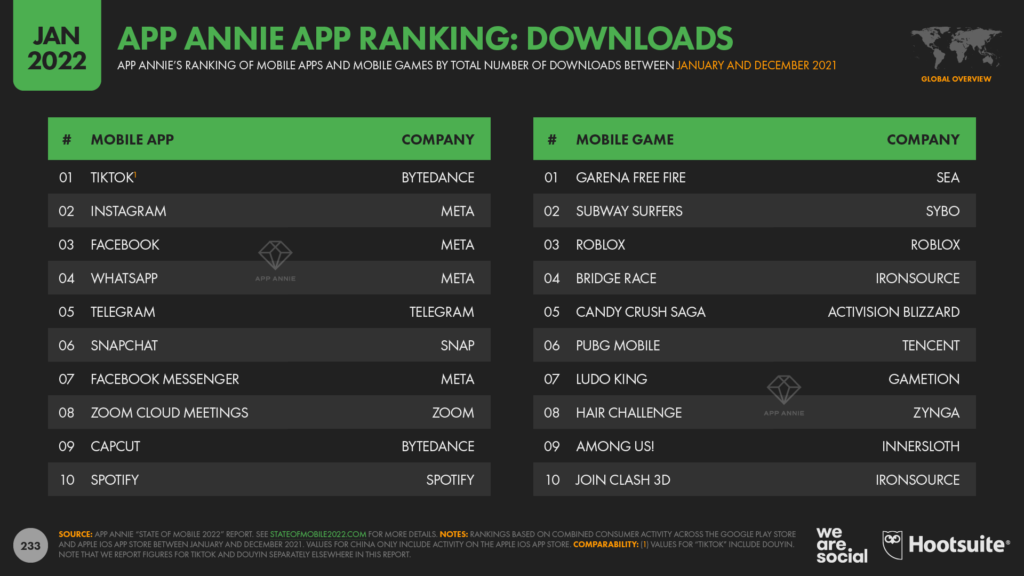
Equally a effect, we might wait to see TikTok brand even bigger gains in these rankings over the coming months, so exist certain to follow our quarterly Statshot reports in 2022 to proceed track of its progress.
Dig deeper: take a closer look at how social media favourites vary past age and gender in this article.
Time spent using connected tech continues to rise
One of the acme stories at the outset of the COVID-19 pandemic was how much more the globe came to depend on the internet, especially as countries entered lockdown.
Nonetheless, despite fluctuations in movement restrictions over the past two years, the latest information show that people are in fact spending more time than always using connected tech.
Cyberspace time
Research from GWI reveals that the "typical" global internet user now spends about seven hours per day using the cyberspace across all devices.
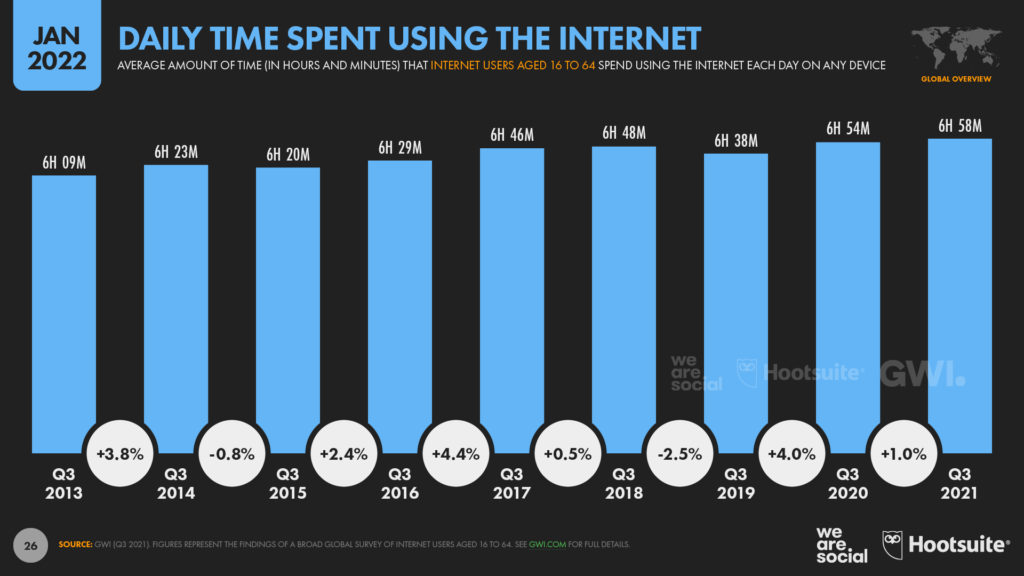
For context, if we presume that the average person sleeps for roughly 7 to 8 hours per day, the typical cyberspace user now spends more than 40 percent of their waking life online.
The amount of time we spend online continues to climb also, with the daily average increasing by four minutes per 24-hour interval (+1.0 percent) over the past yr.
That may not sound like a big increase, but added upwardly beyond all of the world'south internet users, those four extra minutes per twenty-four hours should equate to more than five billion boosted days of internet use in 2022.
In total, the latest numbers suggest that the world should spend more 12½ trillion hours online in 2022 lone.
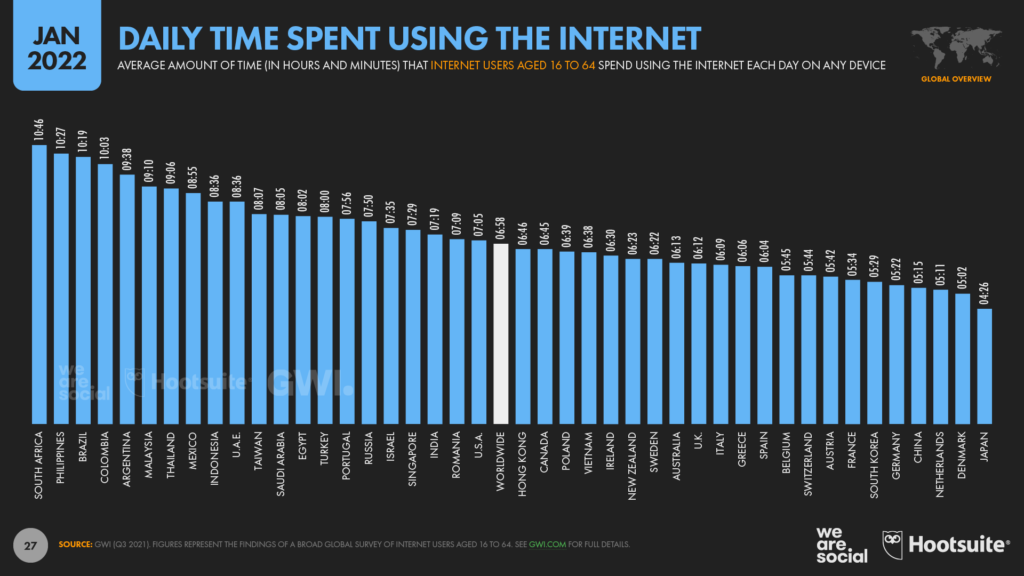
As with well-nigh information points in our Global Digital Reports, however, there are considerable differences in time spent by geography.
Southward Africans now spend the greatest amount of time online each day, with the country'south working-historic period internet users saying that they spend an average of 10 hours and 46 minutes using connected tech every 24-hour interval.
Filipinos, Brazilians, and Colombians aren't far behind, with the average net user in those countries each spending more than 10 hours per mean solar day online.
At the other end of the scale, Japanese users spend the to the lowest degree corporeality of time online each day, with the national average still below iv½ hours per mean solar day.
It's likewise interesting to note that China sits quite far downwards these rankings, with the country's internet users saying they spend an boilerplate of 5 hours and 15 minutes per solar day online.
Social media time
At an average of two hours and 27 minutes per twenty-four hours, social media accounts for the largest single share of our connected media time, at 35 percent of the total.
The time nosotros spend using social media has grown again over the past year besides, up by two minutes per mean solar day (+ane.4 percentage).
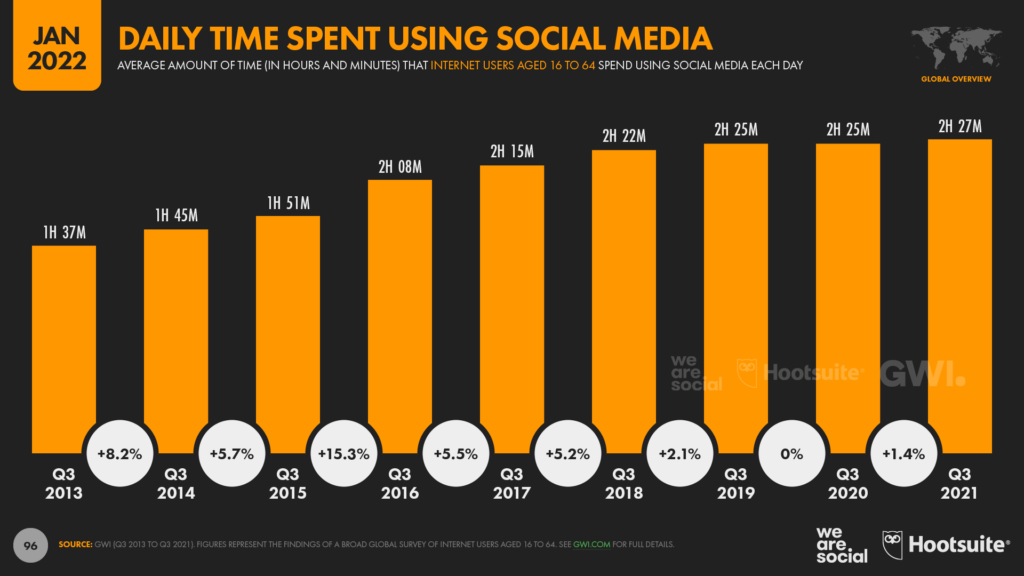
However, social media'south share of overall internet time has really fallen slightly since the commencement of the COVID-nineteen pandemic.
Our assay suggests that this is largely because people accept embraced a variety of new online activities over the past two years, and so – relatively – social media now accounts for a smaller share of total online time than information technology did when people did fewer things online.
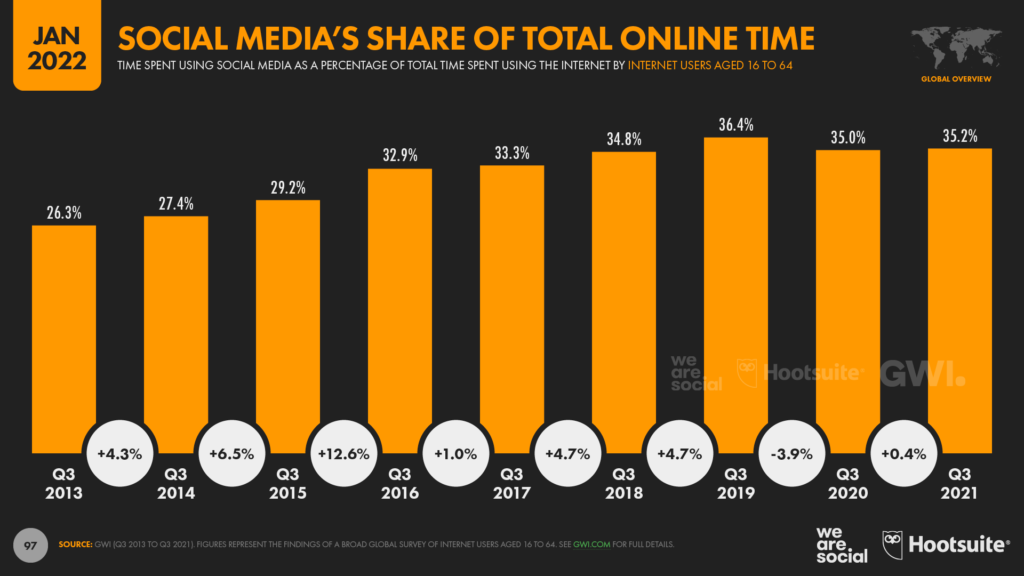
All the same, with the globe fix to spend more than 4 trillion hours using social media in 2022, there's little doubt that social media nonetheless plays a central role in our everyday lives.
Dig deeper: click here to see how social media time compares with time spent watching TV.
Social media time by platform
Just how does that social media fourth dimension break down by platform?
Well, the expert news is that the wonderful folks at App Annie have shared some cracking data with united states this twelvemonth that reveals how much time people spend using the Android apps of several peak social platforms.
For context, handsets running Android account for roughly 7 in 10 smartphones in use around the globe today, so – while these figures may not include all social media users – they still provide rich insights into how the world really uses social media platforms.
Overall, App Annie'southward data shows that YouTube accounts for the greatest total fourth dimension spent using social media apps on Android phones, and it besides clocks the highest average time per user.
App Annie's research indicates that the typical YouTube user now spends almost a full day – 23.seven hours – per month using YouTube's mobile app, simply recall that the platform likely also sees meaningful action on its website, likewise as via embeds on tertiary-party websites.
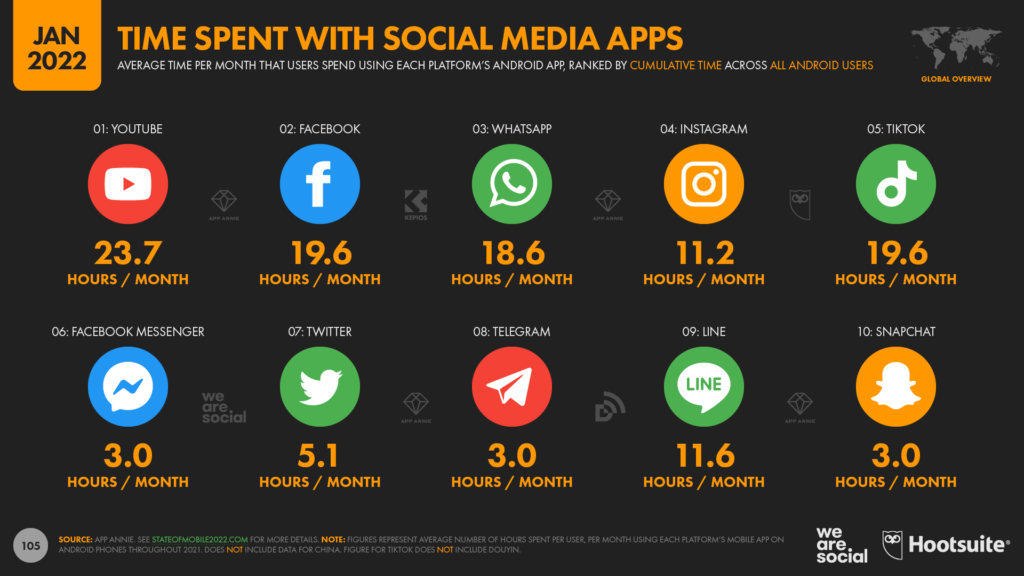
Facebook comes second in terms of total, cumulative time spent using social media apps, with Android users averaging 19.6 hours in the platform's app each month.
TikTok users too clock in an average of xix.6 hours per month using the TikTok Android app, merely because the platform has fewer overall users, TikTok merely comes fifth in these rankings by cumulative time spent across all users.
WhatsApp comes third in terms of total time spent, with users spending an average of eighteen.6 hours per month using the messenger app on Android phones.
Instagram ranks fourth, but users spend considerably less time using the app each calendar month compared with the rest of the superlative 5, at just eleven.2 hours per month.
At xi.6 hours per calendar month, LINE besides sees impressive average use rates, but with considerably fewer users overall, it just places ninth in the global rankings by total fourth dimension spent.
For context, average monthly time per user has remained relatively stable across Facebook, YouTube, and WhatsApp over the past year.
Meanwhile, the time spent using Instagram has increased past x percent year on year, equating to almost one additional hour of use per calendar month.
Nevertheless, TikTok has seen the biggest gains across the tiptop 5 over the past 12 months.
TikTok's users now clock in an extra 6 hours and 20 minutes per month using the platform's Android app compared with this fourth dimension last year, equating to a year-on-twelvemonth increase of 48 percentage.
Information technology's of import to stress that these figures vary considerably by geography though, and local rankings can await quite different to this global picture.
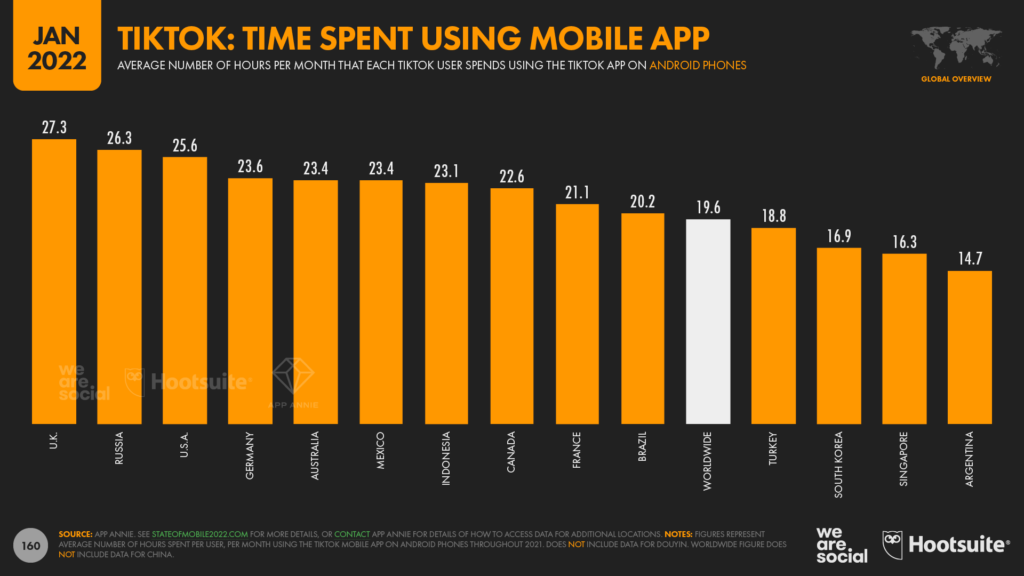
Dig deeper: Explore local data for time spent beyond the top 5 platforms in the full Digital 2022 report.
Facebook is nevertheless the near-used platform
Insights into people'south "favourite" platforms and the time they spend using each one are perhaps the well-nigh representative data points for marketers preparing a social media plan.
However, active user numbers still provide valuable benchmarks, especially when it comes to understanding a platform'due south momentum.
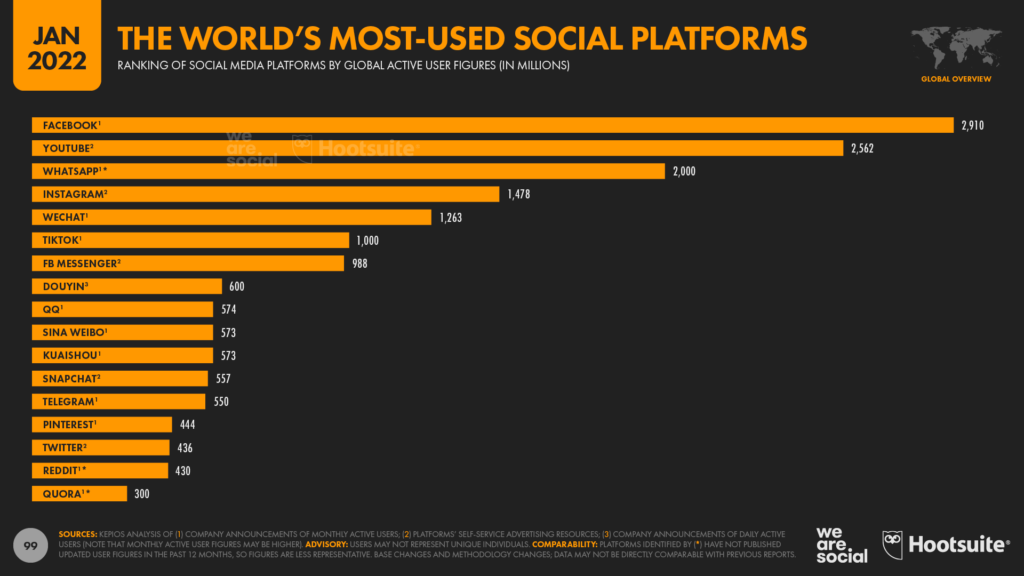
Data published in Meta'due south Q3 2021 investor earnings annunciation confirms that Facebook is notwithstanding the world'due south nigh-used social media platform, with 2.91 billion users every bit of October 2021 (the latest "official" figure at the time of writing).
Facebook's monthly active user base grew by a solid 6.2 per centum (+170 million users) over the past twelvemonth, despite already reaching more than half of its total potential audience by age and accessibility (note that Facebook is still blocked in China).
YouTube has closed the gap with Facebook over the by twelvemonth though, with the platform's audience growing well-nigh twice every bit fast as Facebook'south.
YouTube now has at least 2.56 billion active users, which equates to roughly 88 percent of the latest Facebook total.
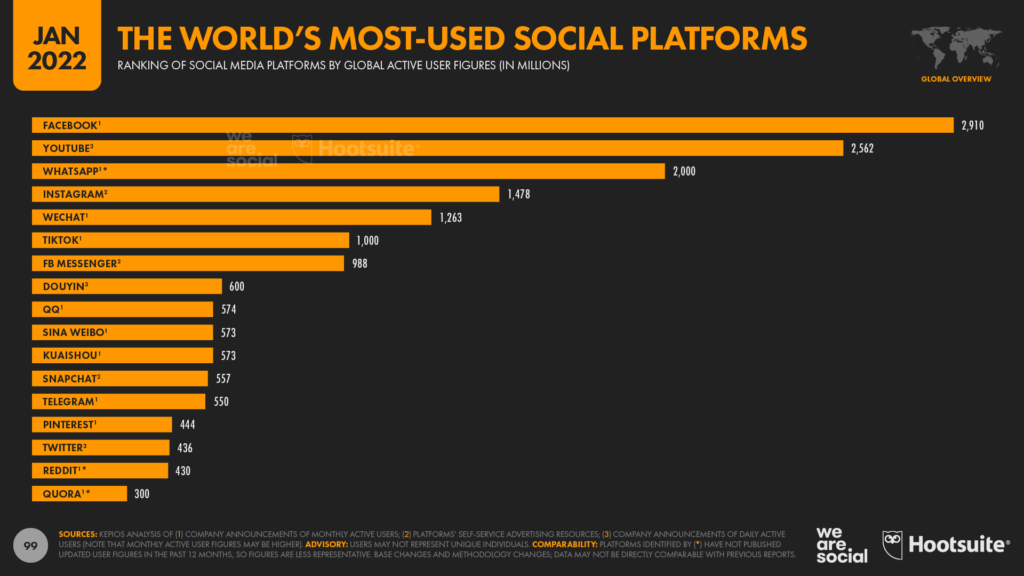
All the same, note that the figures nosotros publish for YouTube are based on the platform's ad audience, whereas the figures for Facebook correspond total monthly agile users.
Meta hasn't published any official updates to global WhatsApp user numbers in the past yr, only it's likely that the platform all the same ranks third, with at least 2 billion agile users per month.
Instagram ranks fourth at a global level, and has seen some of the fastest growth of whatever platform in the past year (y'all'll notice more than detailed analysis of Instagram's growth afterwards in this article).
WeChat closes out the height 5, with China'southward favourite social media platform now claiming 1.26 billion monthly active users.
Yet, all eyes will doubtless be on TikTok, which currently sits in 6th place in these agile user rankings.
Bytedance announced that the platform had passed 1 billion monthly active users dorsum in September 2021, but the company has been characteristically tight-lipped since so, and so that figure remains the latest "official" number.
However, it's worth noting that TikTok'southward active user base roughly doubled between December 2019 and September 2021, and with the platform still claiming top spot in the global app download charts, it's almost certain that TikTok's monthly agile users proceed to grow (more on that beneath).
Meanwhile, Meta hasn't published an "official" monthly active user (MAU) number for Messenger since September 2017, so we've decided to employ the platform's latest ad audience attain figure in these rankings, instead of that older MAU headline.
Note that LinkedIn doesn't publish active user numbers, which is why we're unable to include information technology in this list.
Dig deeper: stay up to date with all the latest social media stats via our dedicated platform pages.
Instagram keeps growing
The latest data published in Meta's advertising resource shows that Instagram's ad reach has jumped past an impressive 21 per centum over the by year, despite important changes in how the visitor reports its ad audience numbers.
Meta's own data suggests that more than than a quarter of a billion new users joined Instagram during 2021, pushing the platform's global ad reach to almost one.5 billion users by the starting time of 2022.
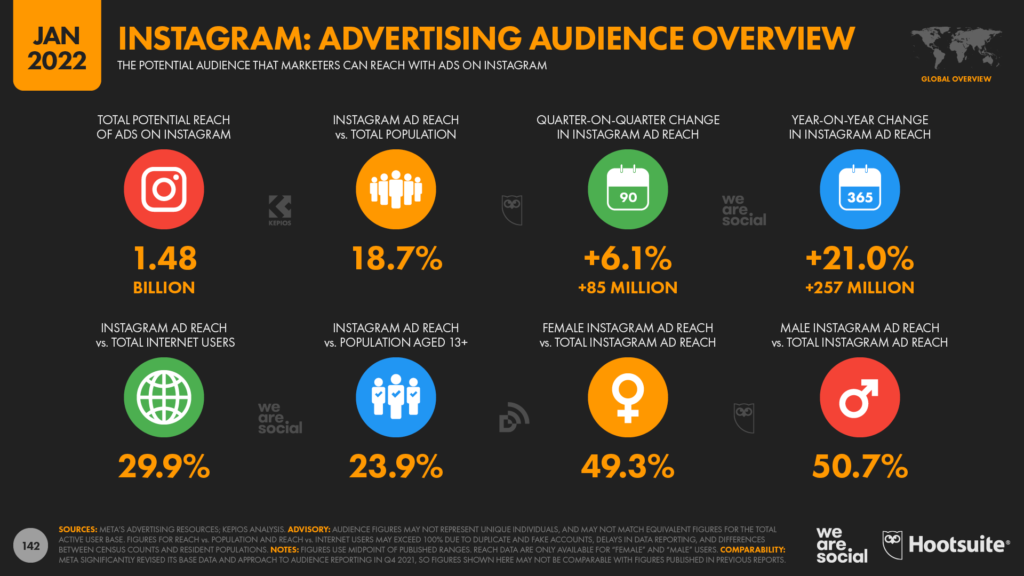
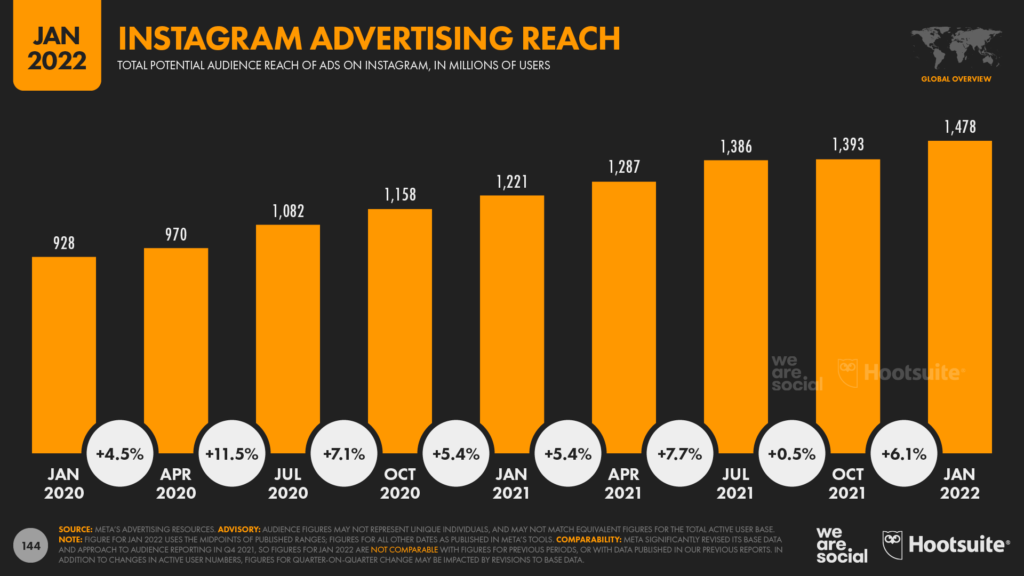
What'due south more, Instagram'southward audition grew by more than half dozen percent (+85 1000000 users) in just the by 90 days, which suggests that its growth rates go on to accelerate
Instagram has been posting impressive quarterly growth rates for some time now, and our analysis of the company'south ad attain numbers indicates growth of nearly 60 percent over the past 2 years.
Our Digital 2022 Global Overview Report besides includes data for some of Instagram'south private 'environments', which volition exist particularly useful for marketers exploring opportunities such as short video formats and social search.
For context, ads in Instagram'southward "home feed" attain almost all (96.6 percent) of Instagram's active user base each calendar month, so these placements remain the surest style to accomplish the largest Instagram audience.
However, ads in Instagram Stories now attain more than than i billion users each month, and – with the format'due south additional functionality and creative options – the Stories surround represents an always more compelling opportunity.
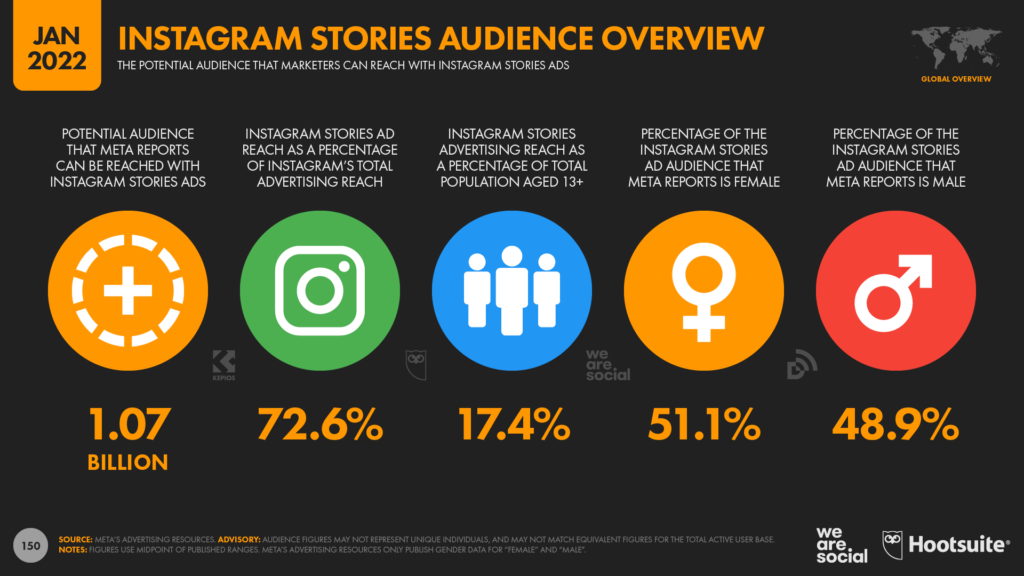
Meanwhile, slightly less than 800 meg users also see ads in Instagram's Explore tab each month.
This finding may have added relevance for marketers launching new brands and products, because users browsing the Explore tab are more likely to be looking for new content, ideas, and inspiration.
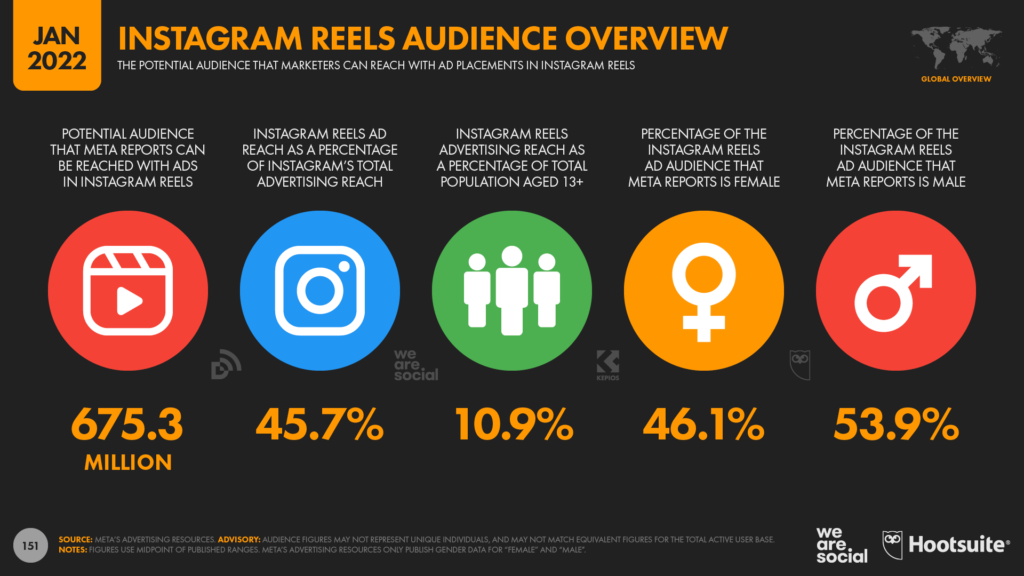
Reels haven't quite gained the same momentum as Stories yet, just information reveals that 675 million Instagram users still run into ads in the platform's dedicated video tab each calendar month.
We'll accept a closer look at Instagram Shop in the social commerce section later in this article.
Dig deeper: click here to explore the demographics of Instagram's diverse advertizing audiences.
TikTok's rapid rise continues
TikTok's advertizement audience also continues to grow at an eye-watering pace.
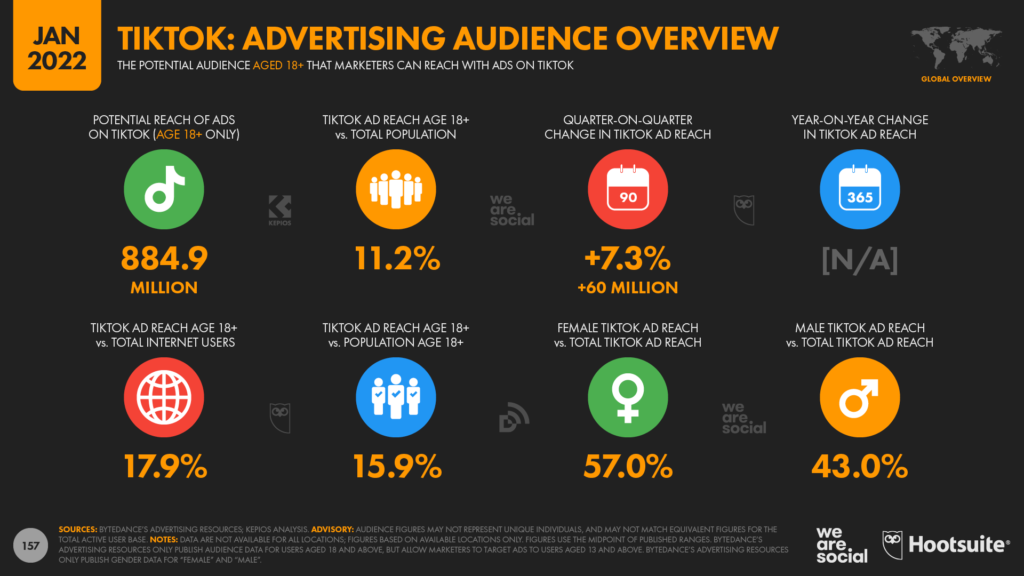
The latest figures published in Bytedance's advertizement resource indicate that TikTok's ad accomplish increased by 60 million users (+7.3 percent) in simply the past ninety days, taking worldwide advertising reach to roughly 885 million by the outset of 2022.
However, it'due south of import to stress that this figure doesn't include users below the age of xviii, who probable brand up a sizeable share of the platform's total active user base [note: due to what the company describes equally "data security requirements", Bytedance'south tools only prove ad reach data for audiences aged 18 and above, although marketers tin still target ads to users aged 13 and above].
The latest information suggest that TikTok has been calculation an average of more than 650,000 new users every 24-hour interval over the past iii months, which equates to virtually 8 new users every second.
And what'south more, despite stereotypes, TikTok isn't simply popular with younger users.
Ad audience data for TikTok users aged 18 and above indicates that more three-quarters of all adults in Kingdom of saudi arabia, the United Arab Emirates, and Kuwait already use the platform.
Meanwhile, TikTok users aged eighteen and above in the U.s.a. now equate to more than half (50.3 percent) of all American adults.
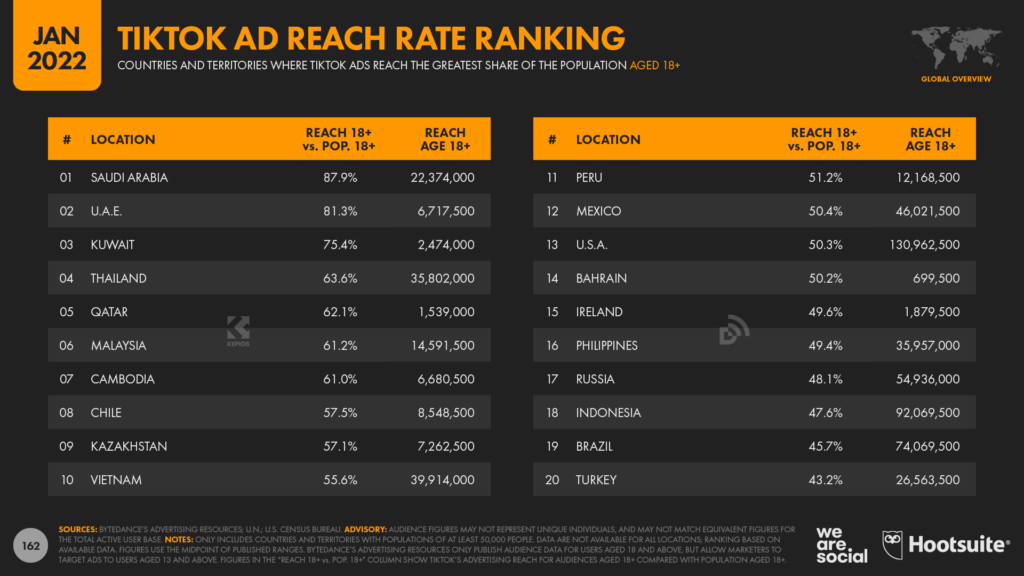
As with all social media audience information in our Global Digital Reports, "users" may not represent unique individuals, but either manner, it'due south clear that TikTok has already fabricated a huge impression effectually the world, and is also an increasingly popular choice.
Dig deeper: read more about TikTok'due south rising and audition profile past clicking here.
YouTube'due south ad reach passes ii.5 billion
Our latest assay reveals that ads on YouTube now accomplish more than 2½ billion users, with that effigy increasing by a hefty 11.nine pct (+271 million users) over the past 12 months.
What's more than, these figures only business relationship for users in around 75 of the globe's larger economies, so there's a very good take a chance that the total attain of YouTube ads is considerably higher than these published figures advise.
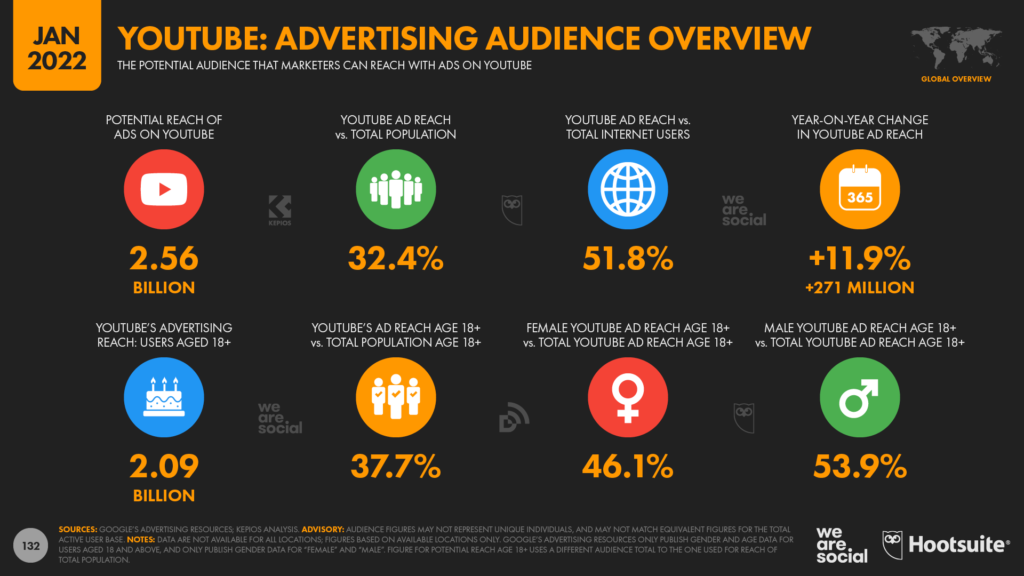
The available data indicate that YouTube ads at present reach roughly 1 in 3 people on Earth, with that effigy rise to 37.7 percent of adults aged 18 and above.
However, if we focus only on those countries for which information are bachelor, a far more impressive story emerges.
YouTube ads now achieve more than three-quarters of adults aged xviii and above across about of the Western world, and more than than ninety pct of all adults in a total of 14 countries.

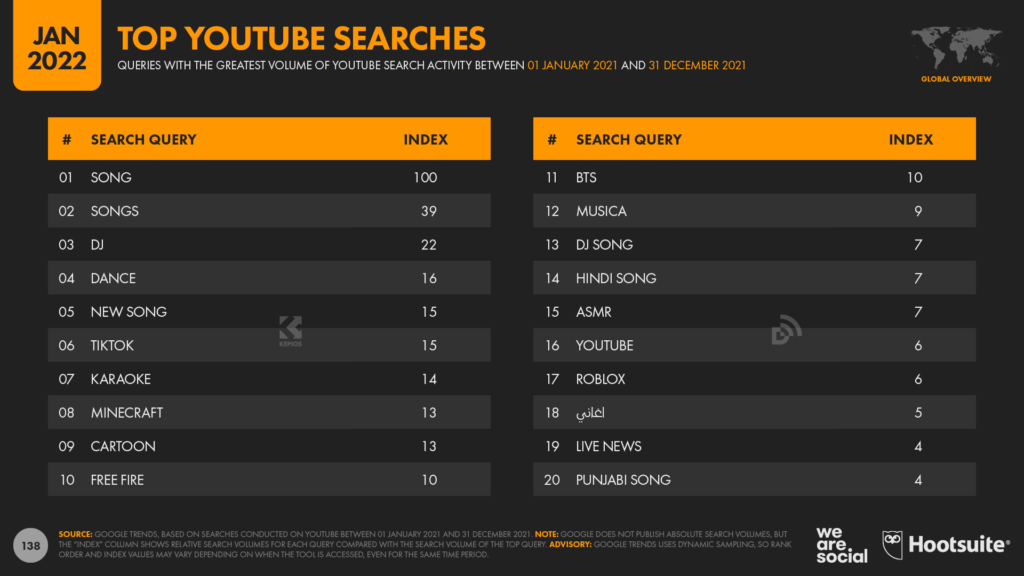
Beyond impressive attain numbers, marketers may also be interested to learn that music is increasingly important for YouTube's global audiences, with 11 of the platform's top 20 search terms over the past year relating directly to music.
This tendency is also evident in our ranking of the platform's nigh-subscribed channels, likewise every bit our updated ranking of the platform'south all-time most viewed videos – both of which you'll find in the full report.
Dig deeper: observe what YouTube users have been watching in our more than granular analysis.
Related: click here to acquire more about how the earth's online video and music habits are irresolute.
Social media for piece of work
GWI'south latest numbers show that most 1 in four net users aged xvi to 64 now uses social media for work-related activities.
Notwithstanding, this figure is considerably higher beyond many developing economies.
At the top of the scale, more than 4 in 10 working-age cyberspace users in Kenya (41.5 percent) say that they use social media for piece of work-related enquiry.
Filipinos and South Africans are also considerably more probable to use social media for piece of work than the global average, with more than one-third of internet users aged 16 to 64 in both countries maxim that social media plays a role in their professional activities.
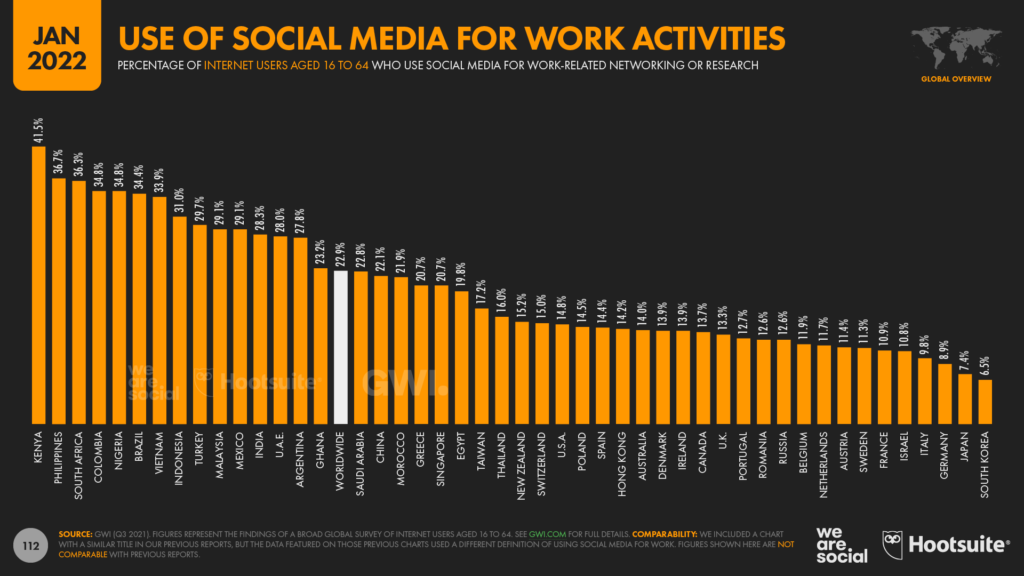
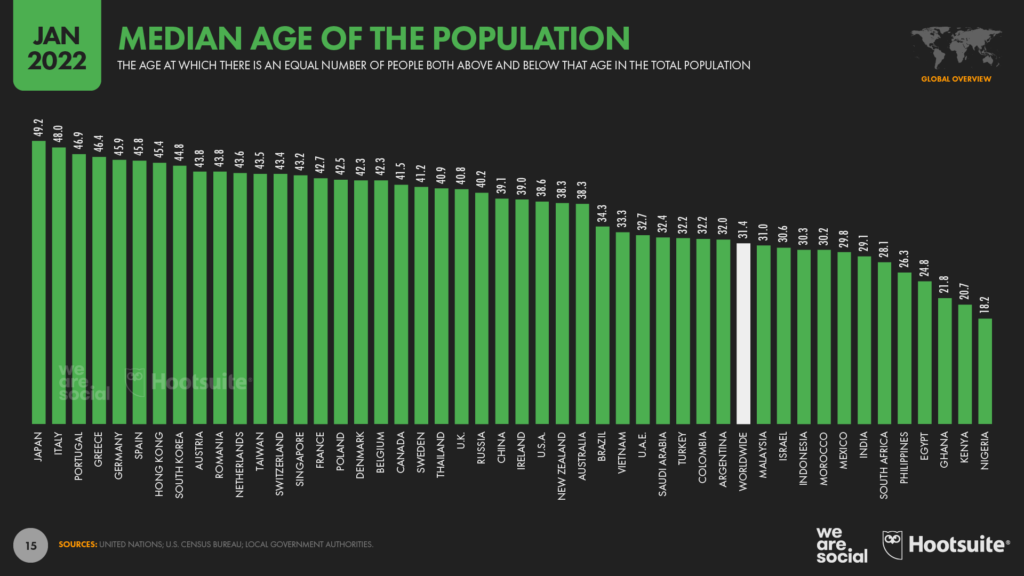
The median age of the overall population appears to play an important role in shaping how likely people in a particular country are to use social media for work, although it's besides worth noting that Hellenic republic seems to buck this trend.
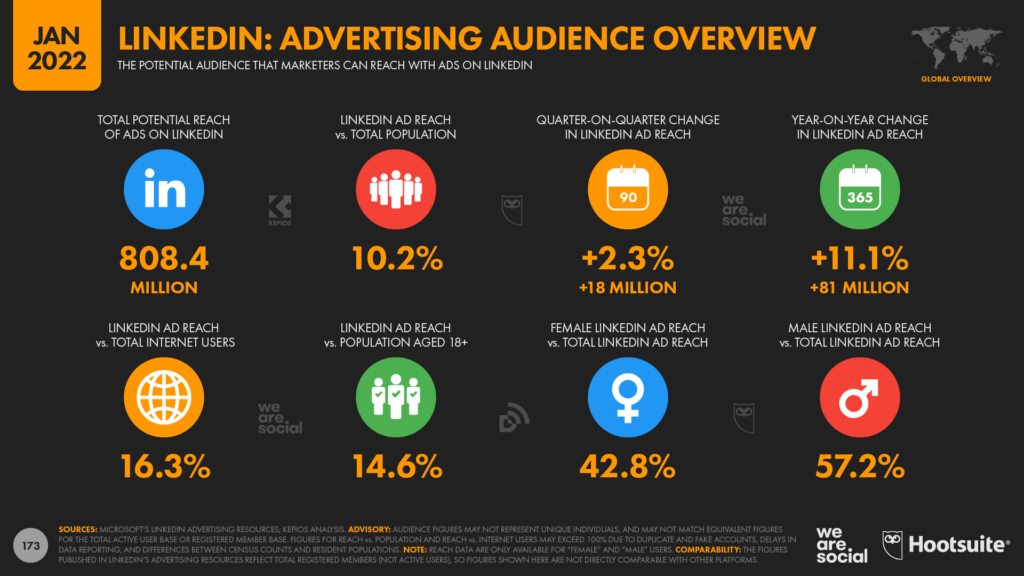
While nosotros're on the bailiwick of professional social media, information technology's also worth noting that LinkedIn has had another impressive yr.
Our analysis of data published in the platform'due south advert resources reveals that LinkedIn'due south registered member base of operations has increased by xi percent over the 12 months (+81 million members), taking the global full to more than than 808 million by the start of 2022.
Dig deeper: nosotros'll be taking a closer look at how people use continued tech at work in our upcoming Digital 2022 Apr Global Statshot report, so look out for that towards the end of Apr.
Big rise on social media ad spend
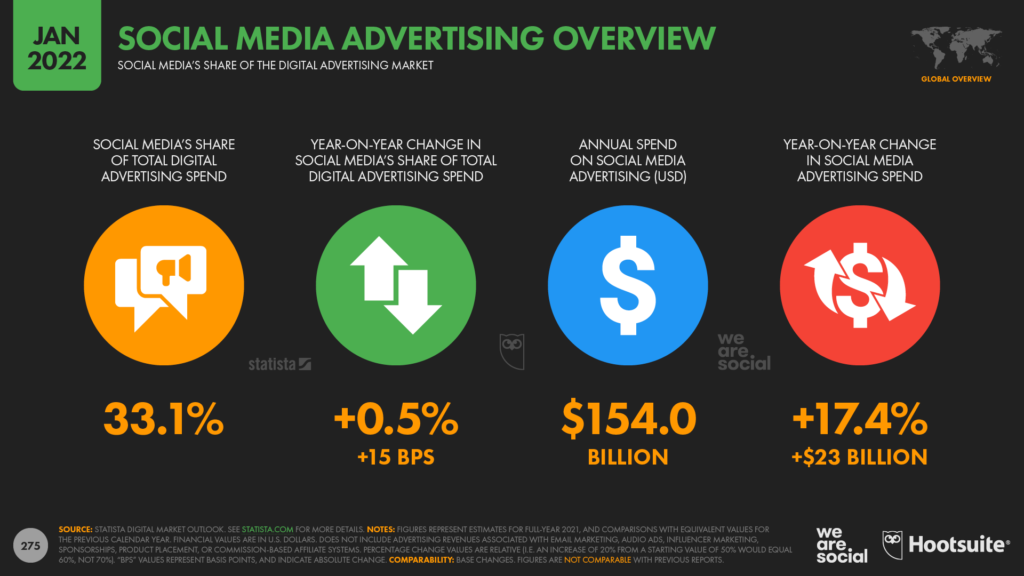
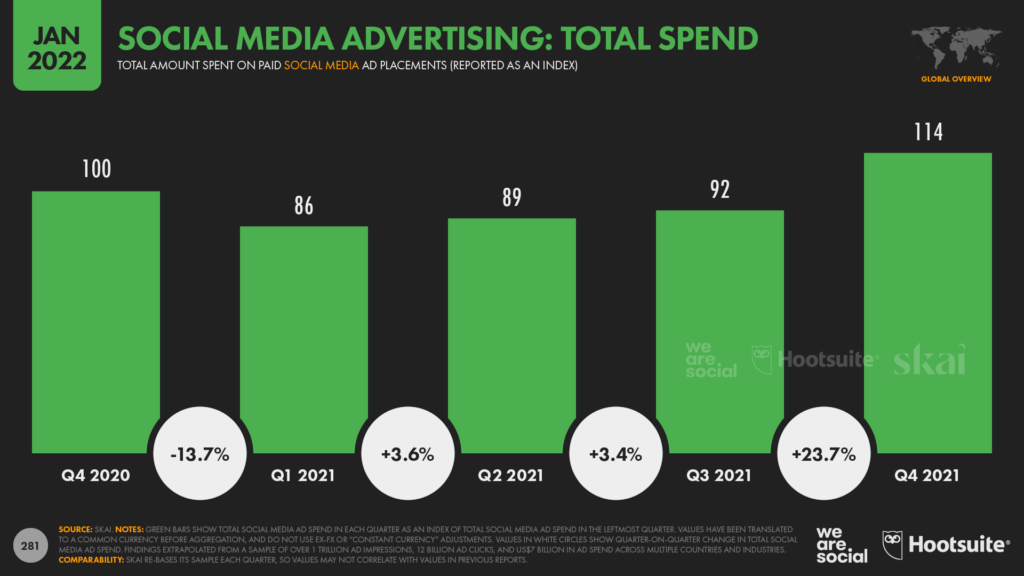
Various data points in this year'south reports reveal that spending on social media ads has jumped significantly over the past 12 months.
For example, data from Statista shows that global social media advert spend exceeded USD $150 billion in 2021, with social media ads accounting for roughly i-3rd (33.ane percent) of total digital spend.
Meanwhile, the latest assay from Skai shows that advertisers spent 14 per centum more on social media ads in Q4 2021 than they did in the aforementioned quarter of 2020.
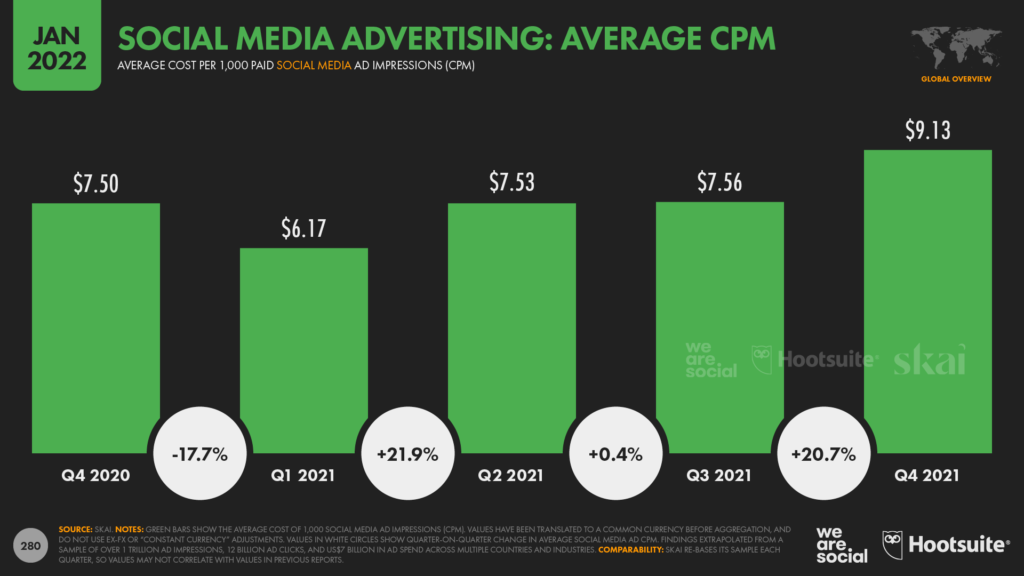
In line with this increase in overall spend, Q4 social media CPMs jumped by 21.7 per centum year on year, with advertisers effectually the world paying an average of USD $ix.13 for 1,000 social media ad impressions across the last 3 months of 2021.
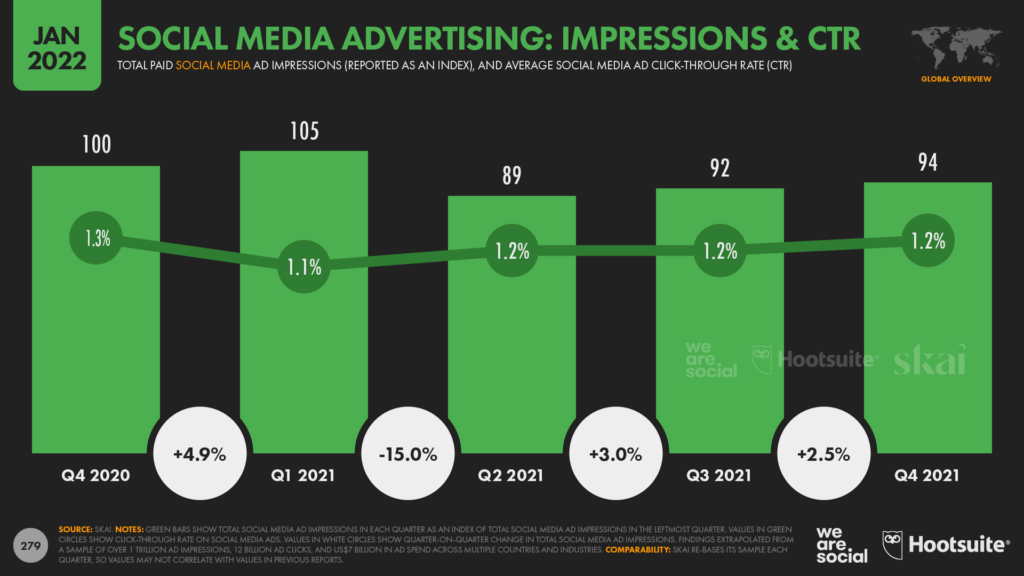
Crucially though, because of the higher average cost per impression, social media advertisers actually delivered fewer total impressions in Q4 2021 compared with the same period in 2020, despite spending more overall.
Related: click hither to learn which social media platforms drive the greatest share of web traffic.
Social media's role in the marketing mix
Despite those ascension ad costs, marketers will exist reassured to larn that new research confirms the effectiveness of social media advertising.
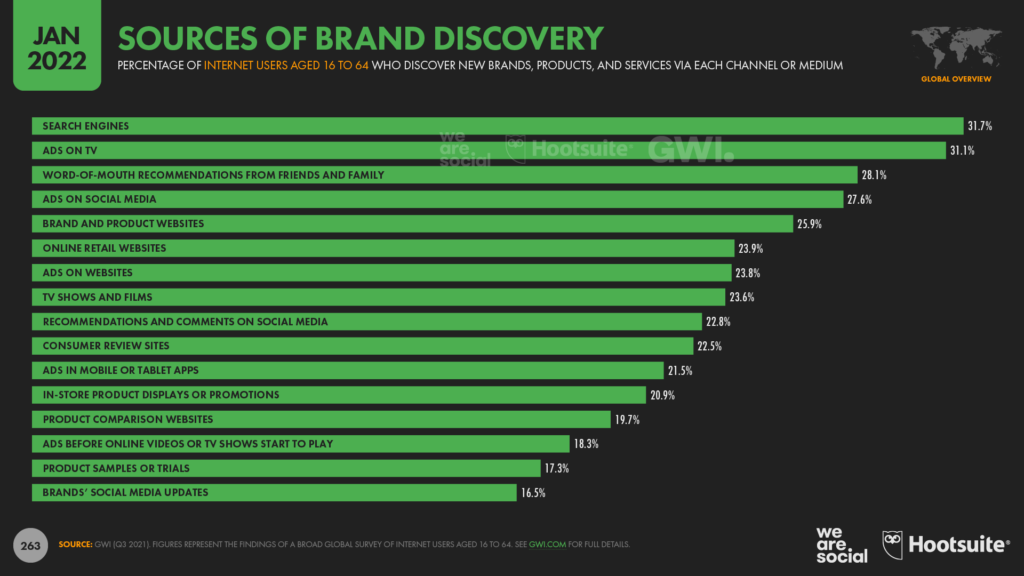
GWI's latest data reveals that more than 1 in 4 net users anile sixteen to 64 (27.half-dozen per centum) observe new brands, products, and services via social media ads, which is just slightly less than the figure for TV ads (31.1 percent).
Search engines are still the top source of new make discovery for the world's internet users though, with 31.seven percent of GWI's sample saying that they've learned almost new brands via an online search.
Meanwhile, discussion-of-oral fissure recommendations too rank highly for brand discovery, then marketers may want to re-examine how easy information technology is for audiences to share their brand and its various online presences via messenger apps like WhatsApp and Telegram.
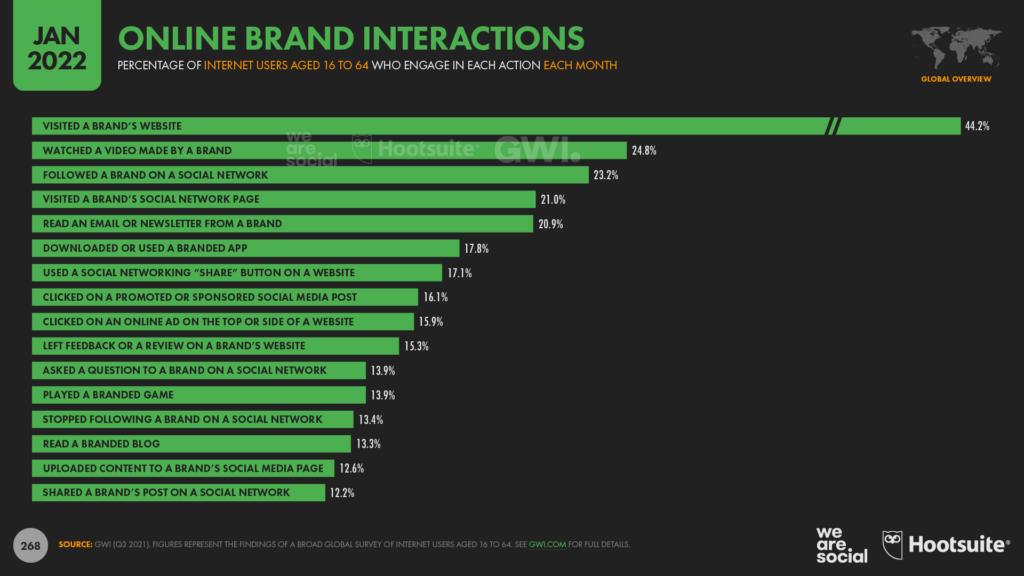
In addition to paid placements, it'southward also worth noting that just under one in 4 working-age internet users (23.2 pct) actively likes or follows a make on social media every calendar month, while near 1 in viii (12.ii per centum) says that they (re)share brands' social media posts at least in one case per month.
GWI's research shows that brands' social media activities play an important role at other stages in the purchase cycle besides.
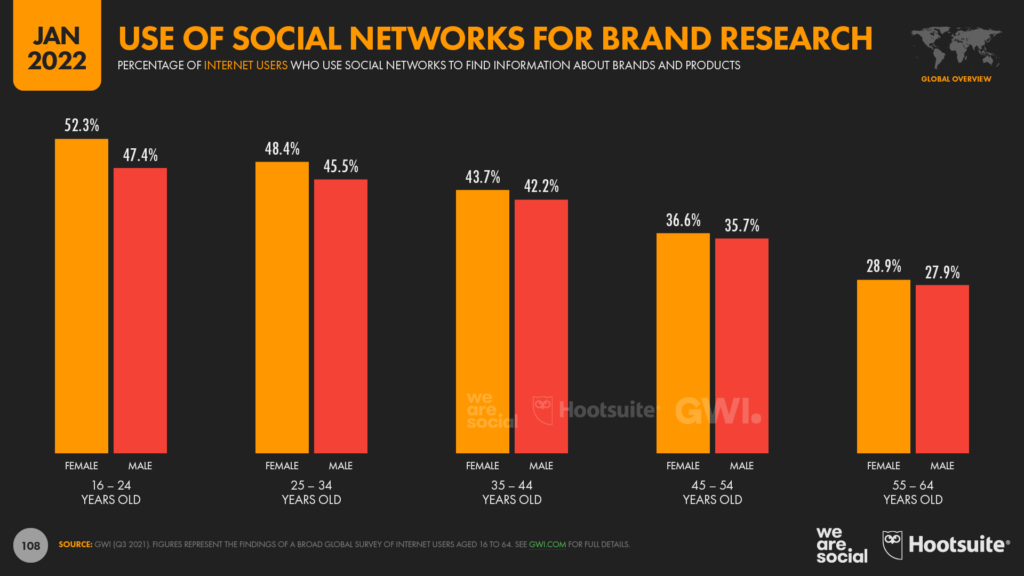
For example, more than iv in 10 working-age internet users say that they visit social networks specifically to research brands and products that they're thinking of buying, with this effigy rise to half of all internet users aged 16 to 24.
Simply aslope all of these positive findings, there are also some more worrying trends in this year'south information.
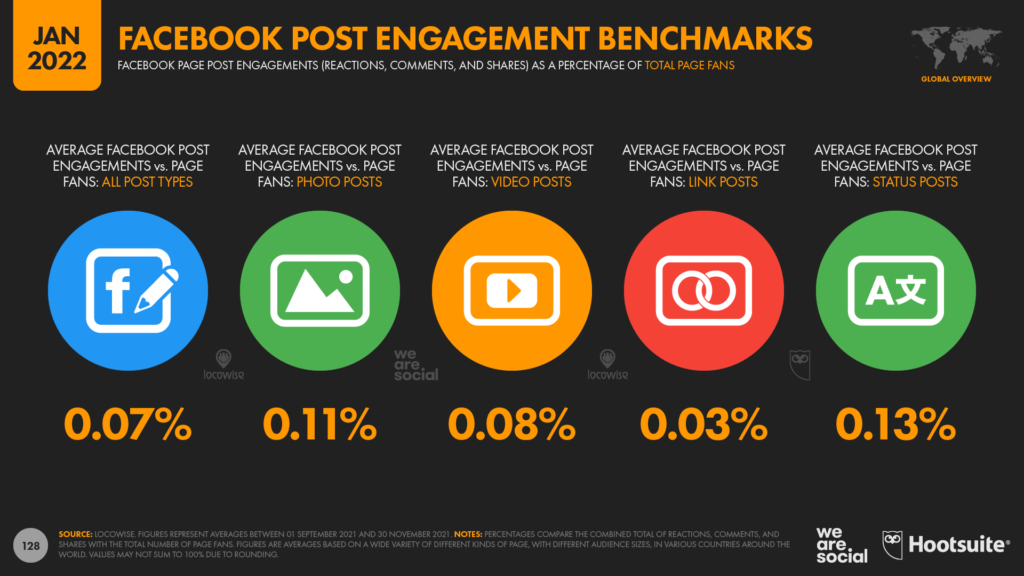
For example, the latest data from Locowise indicates that Facebook pages tin now await an average engagement charge per unit of just 0.07 percent.
That means that – on boilerplate – just 7 fans in every 10,000 will react to, comment on, or share any given postal service.
And even more disturbingly, that average falls to just 0.05 percentage for pages with more than than 100,000 fans.
Related: explore insights into social media marketing effectiveness in Hootsuite'due south Social Media Trends 2022 report.
The representativeness of ad
Another troubling finding in this year's information is that barely ane in 6 working-age internet users (17.three percent) says that they experience represented in the ads that they encounter, regardless of the advertising medium.
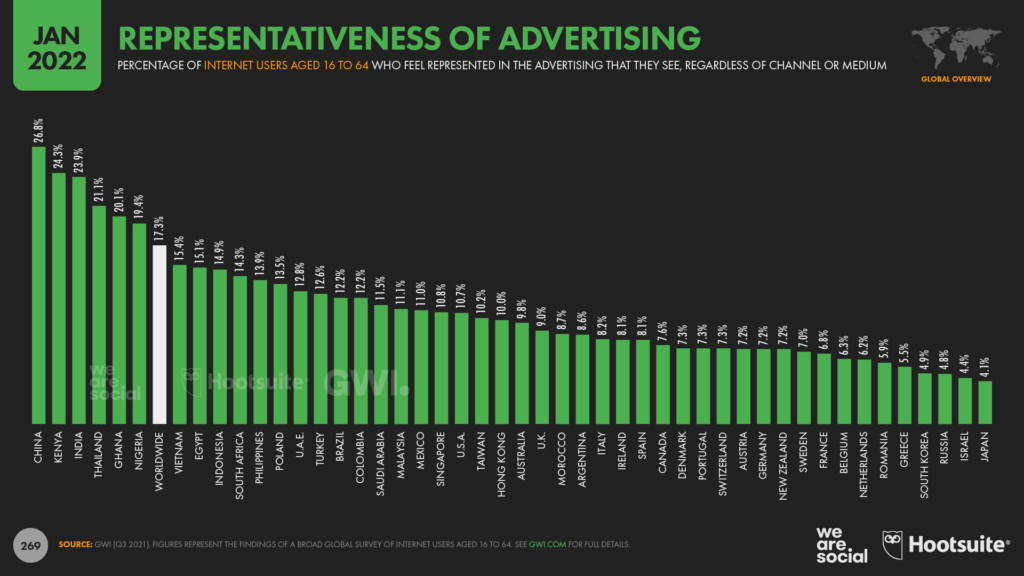
At the better finish of the scale, GWI reports that people in Communist china are the virtually probable to say that they feel represented in ads, with simply over 1 in iv (26.8 percent) answering in the affirmative.
However, just 1 in 9 Americans has a similar perspective, and the figure drops to simply 1 in 11 for people in the U.k..
Japan sits at the bottom of the rankings, with just 1 in 24 respondents in the country saying that they feel represented in the ads that they encounter – and this despite Japanese brands spending more than than USD $47 billion on advertising in 2021.
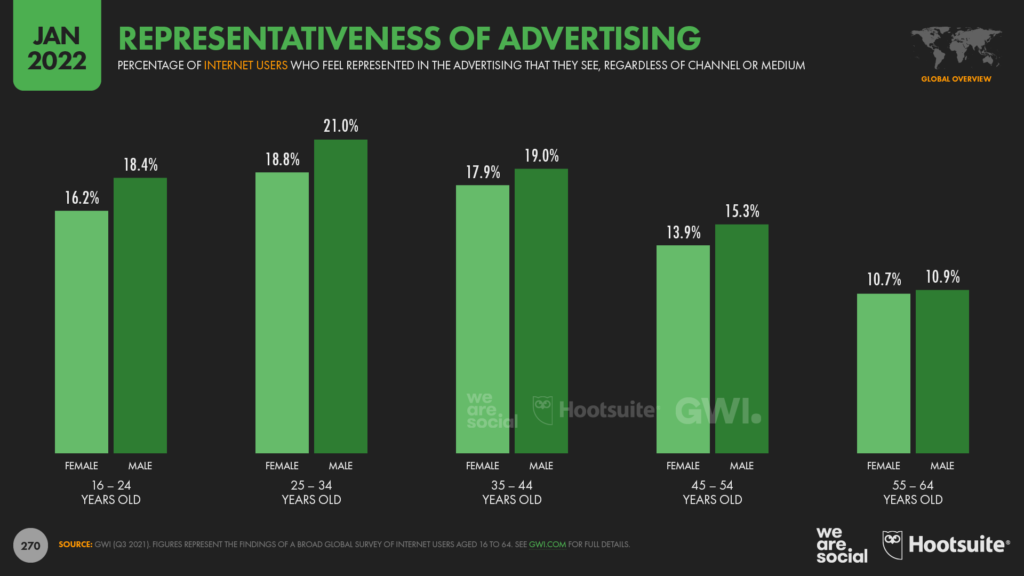
However, this poor issue may in part be due to Japan's high median age.
Indeed, GWI's information highlight the fact that – all over the world – older people feel peculiarly detached from advertising, with just ane in 9 global cyberspace users aged 55 to 64 (10.8 percent) saying that they recognise themselves in the advertising that they see.
But therein lies one of the many challenges in interpreting and acting on this data.
Should advertizing actually reflect the audience that information technology'south aimed at, or should information technology offer an alternative perspective (e.g. a more "aspirational" lifestyle)?
This is one of the more contentious questions in marketing, and – sadly – there are no simple answers.
The best advice I can offer is to invest both time and resources in understanding not only what your specific audience's life looks like, just too in understanding people'southward hopes, dreams, and fears.
Conventional research will exist an invaluable tool here, and many of the information partners featured in this twelvemonth'south reports will be able to help.
Similarly, while social listening may not make the media headlines it used to, I firmly believe that regular social listening can provide some of the most powerful insights into what people actually intendance almost.
And then, every bit you put the finishing touches to those 2022 plans, be sure to put aside some time and money for active exploration of what matters to your audiences, and what "ad representativeness" might look like on their terms.
Related: learn about the latest cultural themes shaping advertisement effectiveness in Nosotros Are Social'south Think Forward 2022 report.
Ecommerce trends
Equally we predicted in our Digital 2021 reports, the increases in ecommerce adoption that we've seen since the start of the COVID-19 pandemic bear witness no signs of abating, fifty-fifty equally movement restrictions come and become.
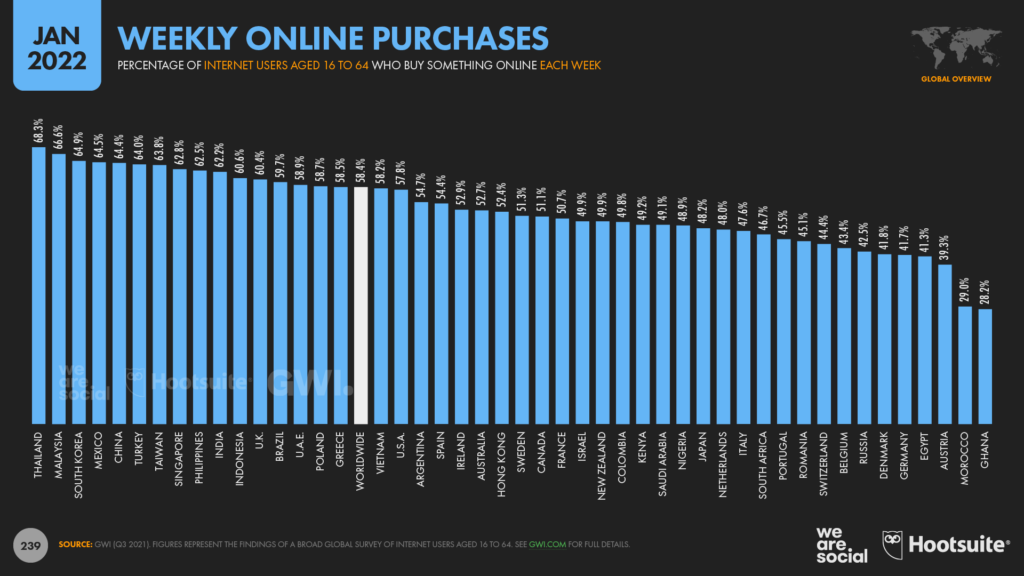
Data from GWI shows that near 6 in 10 working-age net users (58.4 percentage) now buy something online every week, with that effigy continuing to rise throughout 2021.
Many of our lockdown-inspired behaviours have also endured, even as people venture dorsum out into the earth.
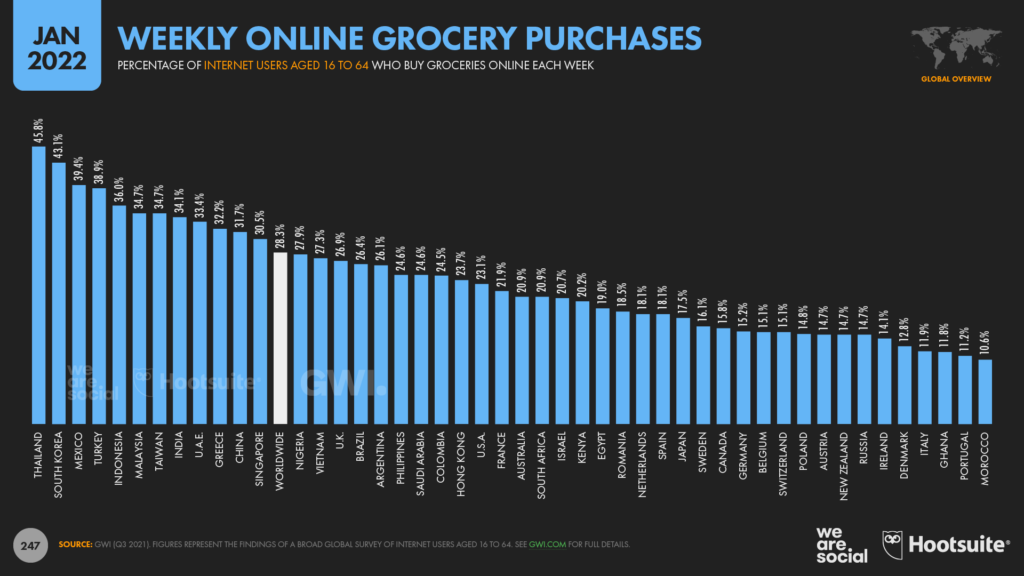
For example, almost 3 in x of us (28.3 percent) at present buy groceries online every calendar week, with the absolute number of online grocery shoppers increasing by 10 percent in just the past 6 months.
Meanwhile, spending in the grocery category has grown even faster than user numbers have.
Figures in Statista'southward Digital Market Outlook show that online spend in the the Nutrient and Beverages categories grew by more 35 percent during 2021, with total annual revenue across these two categories reaching $588 billion.
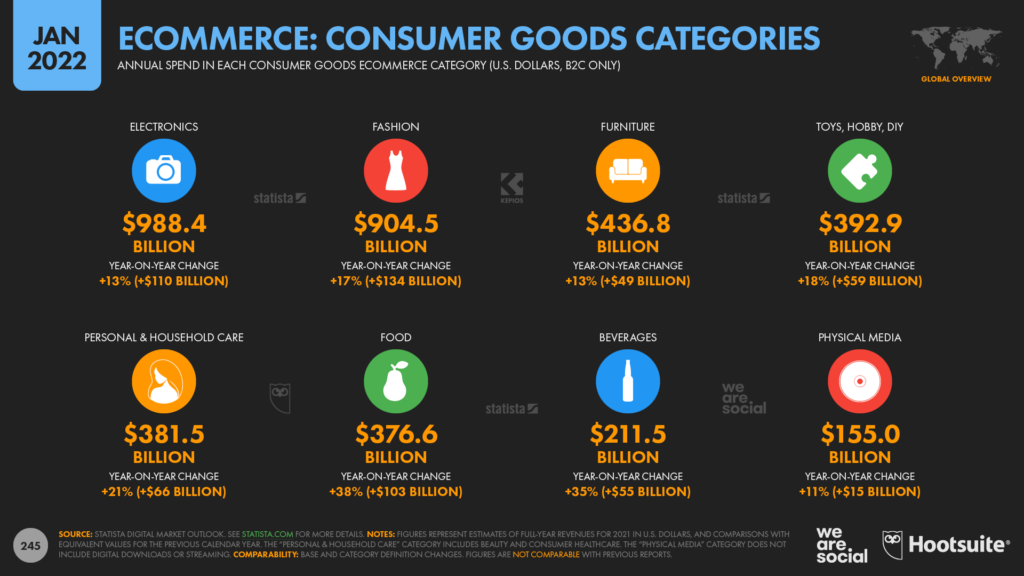
Overall, global revenues associated with online purchases of "consumer goods" – which include groceries, style, electronics, and other household items – increased by more than half a trillion The states dollars during 2021 (+xviii percent), reaching a total of USD $3.85 trillion for the year as a whole.
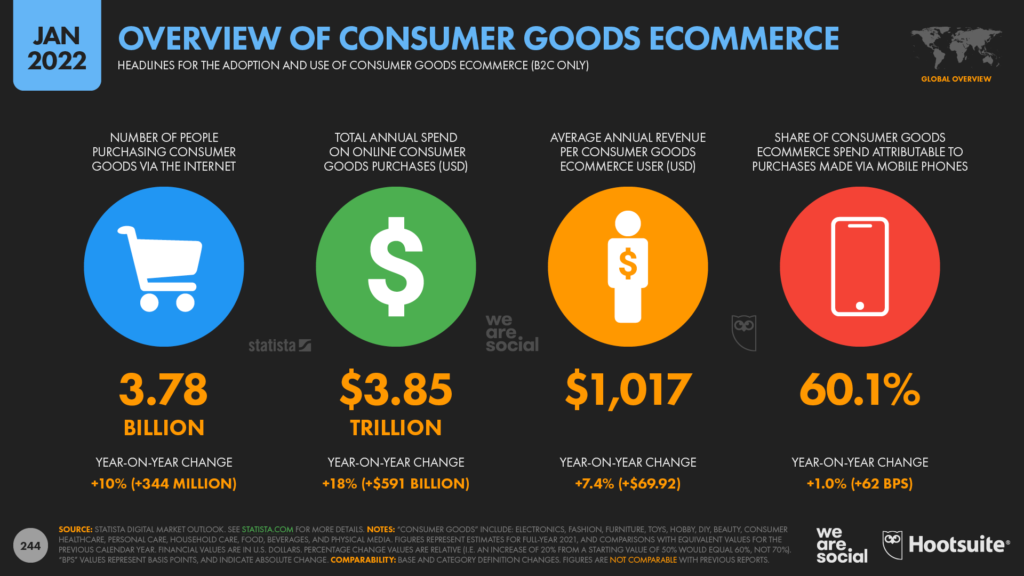
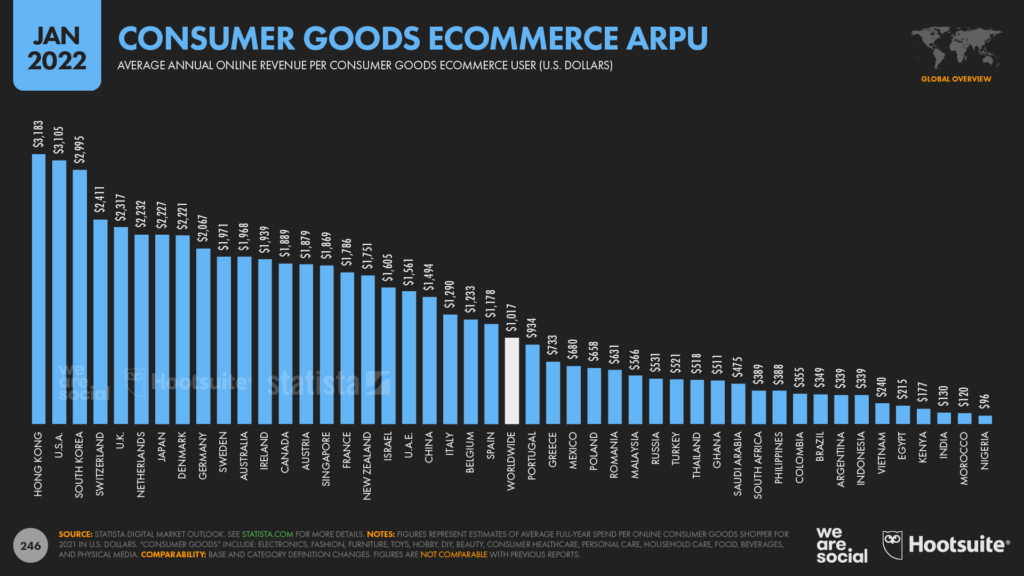
Statista's data also reveals that the world'southward ecommerce shoppers at present spend an average of more than than USD $ane,000 per person, per twelvemonth on online consumer appurtenances purchases.
Nevertheless, again, the story varies considerably by geography.
Boilerplate revenue per user (ARPU) for online consumer goods purchases at present exceeds USD $iii,000 per yr in Hong Kong and the United States, but remains below USD $100 in Nigeria.
In that location's some more optimistic news for travel brands in this year's data, too.
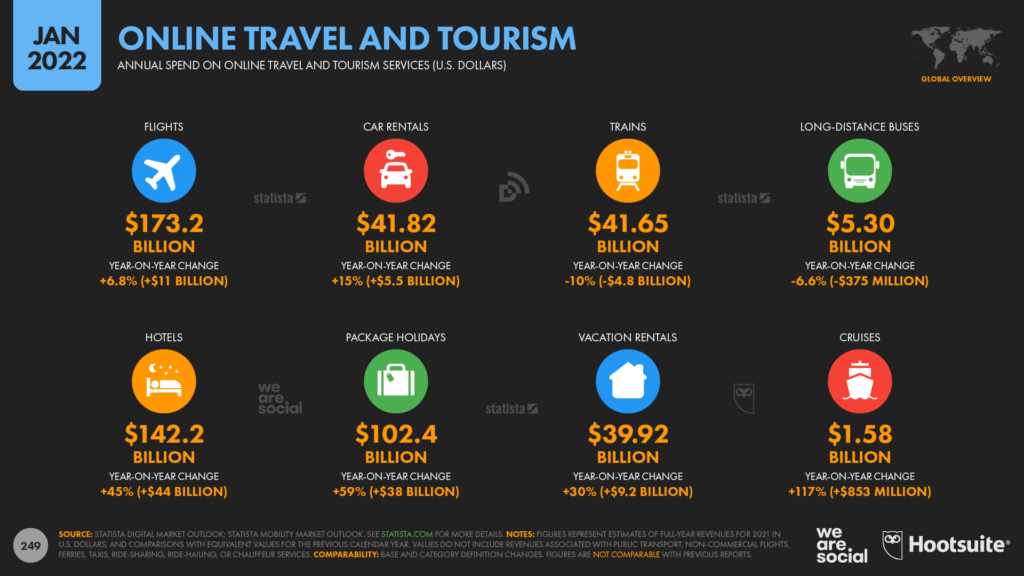
Online travel revenues remain considerably lower than they were in 2019, but consumer spending has increased steadily over the past 12 months.
Statista'southward Mobility Market Outlook reports that global online spend on flights grew past USD $xi billion (+6.8 percent) in 2021, reaching a total of USD $173 billion for the year.
The value of online hotel bookings has increased even faster though, with global revenues up by 45 percent compared with last twelvemonth.
The globe spent $142 billion on online hotel bookings in 2021, with annual revenues increasing by USD $44 billion compared with the overall total for 2020.
But the latest data also reveal that ecommerce isn't just about getting "the latest and greatest".
Research from GWI reveals that 'recommerce' is as well an increasingly popular choice, with one in seven internet users anile 16 to 64 (xiv.4 pct) buying a used or 2nd-paw item online each calendar week.Additional data: for a comprehensive expect at the latest ecommerce stats and trends, check out Shopify's first-class new Future of Commerce reports, which our Global Digital Reports team also contributed to.
Social commerce takes off
New additions to this yr's reports include figures for advertizement reach on Facebook Market and Instagram Shop.
These figures but represent the number of users that marketers can achieve with ads in these environments, and they may not correspond the full extent of each environment's total active user base.
Indeed, Meta reports that more than than one billion Facebook users access Marketplace each calendar month, so at that place seems to exist quite a big gap between total Market users, and the share of those users that sees ads within Facebook'south commerce surround.
Nonetheless, this gap exists across other Meta products too, and our analysis suggests that Facebook's overall ad reach but equates to most 72 percent of the platform'south total monthly active user figure [discover some potential explanations here].
What's more, these Market place and Instagram Shop figures nonetheless tell a compelling story, and further demonstrate that social commerce has already gained rapid momentum.
For example, ads in Facebook Market now reach more than 560 million users each month, equating to more than a quarter of the platform'south total advertising reach.
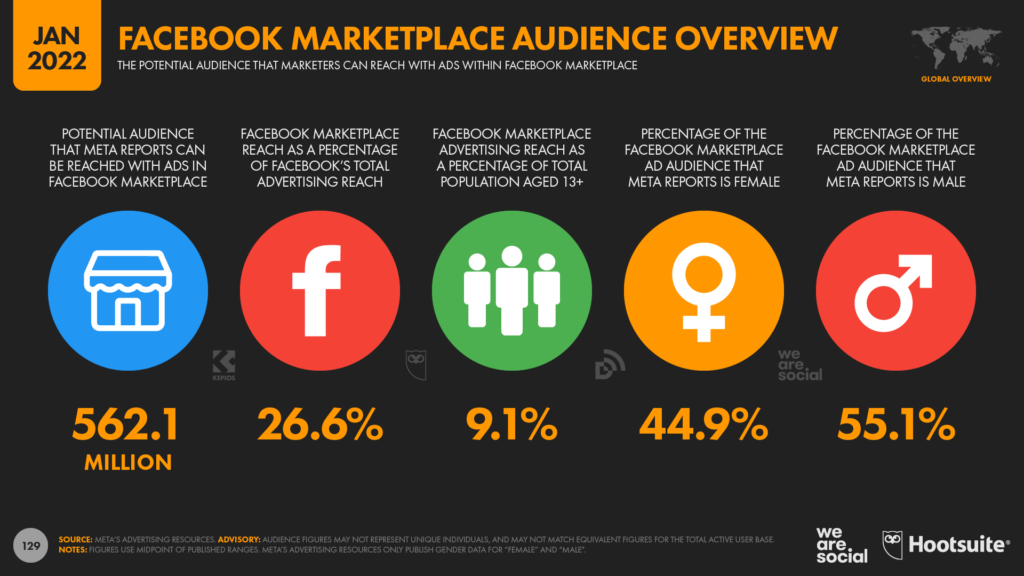
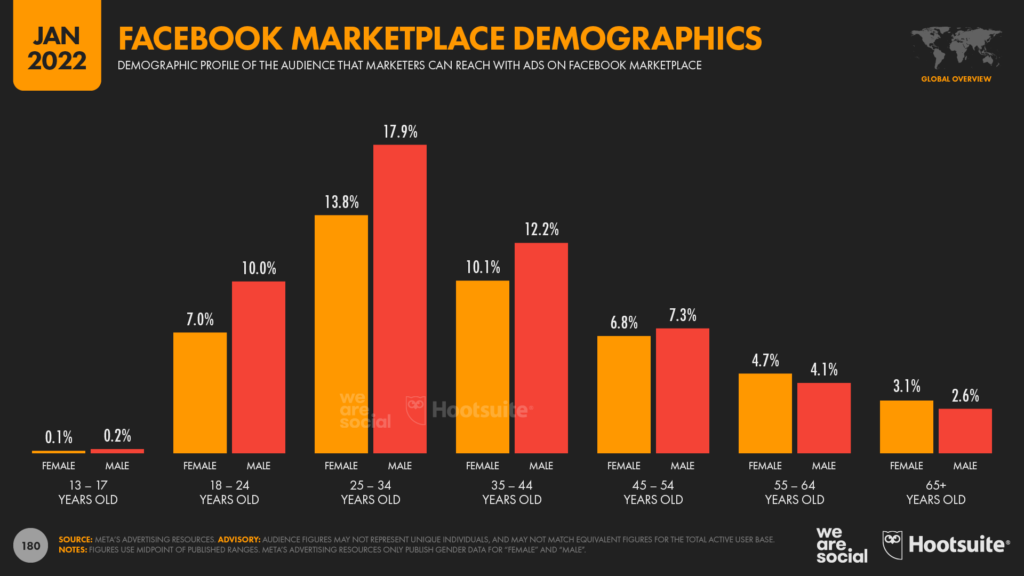
In line with overall platform demographics, Facebook Marketplace attracts a larger male audience, with men accounting for 55 percent of the Market place audience.
Nevertheless, the more than interesting finding is that the Market place audience tends to be considerably older than the Facebook audition as a whole.
Users over the age of 35 business relationship for more than than half (50.9 percent) of Marketplace's global ad audience, yet they account for just 40.9 percent of Facebook'due south overall ad audition.
Note that Facebook limits apply of Market to users aged 18 and above, which explains why figures in the everyman age bracket are so depression.
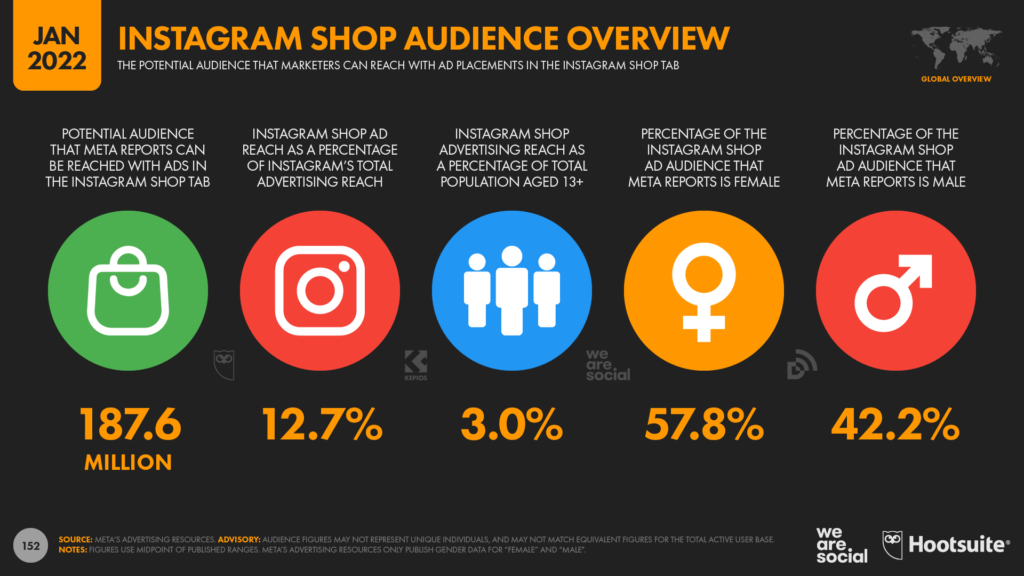
Instagram Shop has as well started to gain momentum, with Meta'south tools reporting that advertisers tin can now attain more than than 187 million users with ads in the Store tab each month.
Nonetheless, in dissimilarity to the findings for Marketplace in a higher place, the data indicate that women account for a much greater share of Instagram Shop's global advert audience.
Related: could social commerce aid Meta build an alternative to its ad-funded model? Learn more than in our detailed assay.
Mobile apps are a serious business
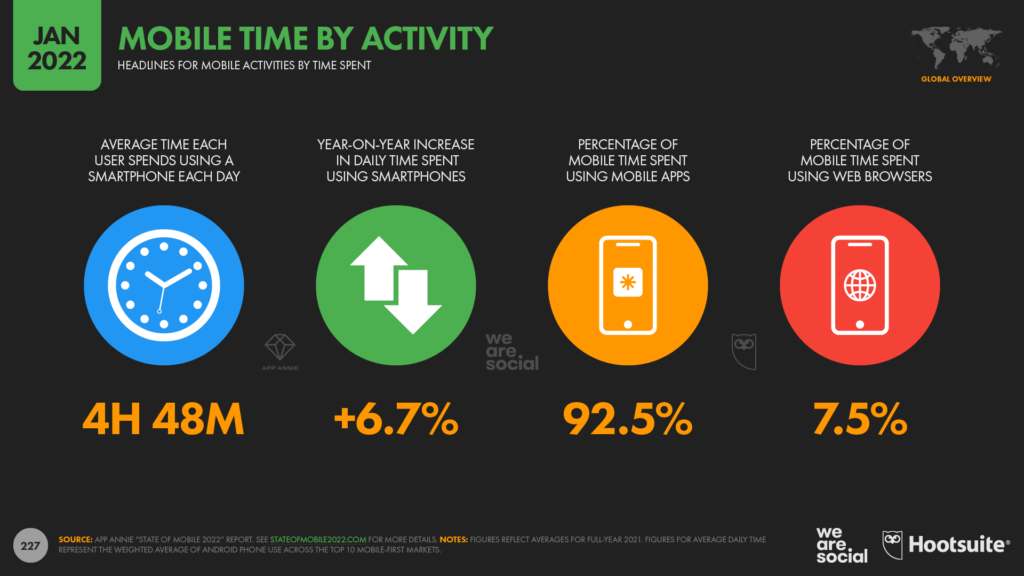
App Annie'due south new Land of Mobile 2022 report reveals that the typical mobile user now spends an average of 4 hours and 48 minutes per user, per day using their phone.
That means that the world'southward 5.iii billion mobile users will spend more than ane billion years of combined human fourth dimension using mobile phones in 2022.
And all that time adds up to serious money, likewise.
In add-on to the handset revenues that helped to propel Apple Inc. to a USD $three trillion market cap earlier this month, the globe's smartphone users spent a combined total of USD $170 billion on mobile apps and in-app purchases in 2021.
Based on Ericsson's latest figures for the number of handsets in apply around the earth, that equates to an average of more than USD $27 per handset.
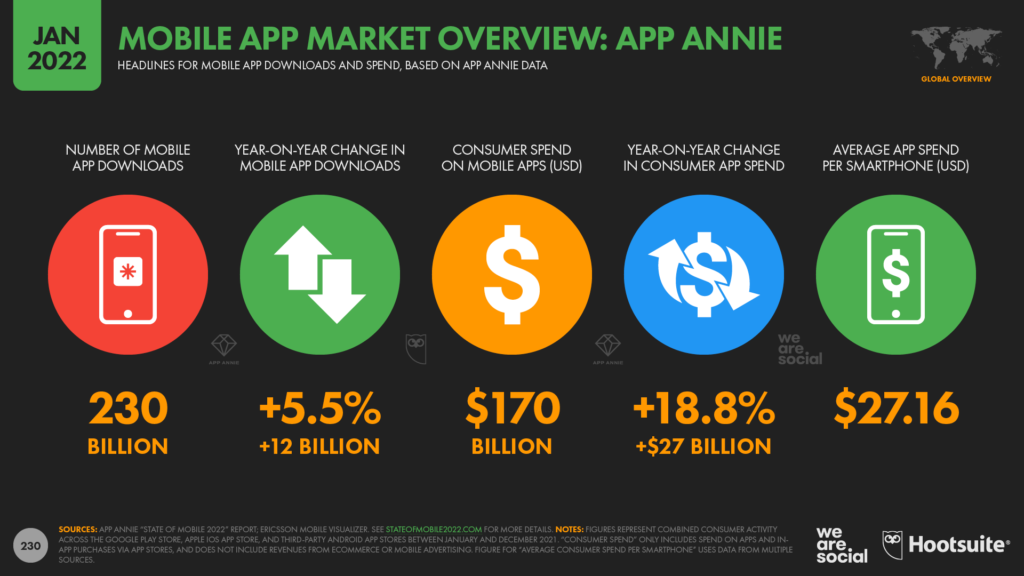
That may not sound like a huge corporeality, only to put those figures in context, worldwide consumer spend on mobile apps now equates to roughly 0.2 percent of full global GDP.
What's more, these revenue figures merely include transactions made directly through app stores, and don't include things like ecommerce purchases made via mobile apps, or mobile ad revenues.
Consumer spending on apps continues to increase as well, with 2021 revenue increasing by almost 19 percent compared with the total for 2020.
Additional data: detect more great mobile insights in App Annie'south excellent State of Mobile 2022 report.
Mobile connections accelerate
And in more good news for the mobile economic system, cellular information connection speeds also proceed to accelerate.
Assay from Ookla reveals that the median worldwide download speed via mobile connections increased by roughly a third over the by yr, and more than than half of the world's mobile internet users at present savor data connectedness speeds in backlog of 29 megabits per 2d (Mbps).
For context, 29 Mbps is more fast plenty to stream a 4K video without any buffering.
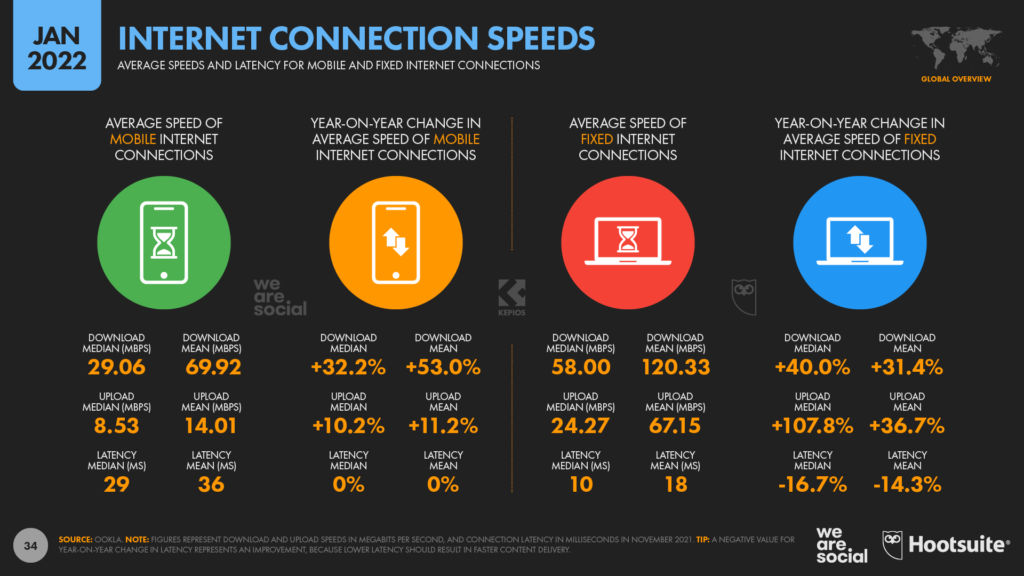
Annotation that Ookla recently changed its focus from mean speeds to median speeds though (click here to sympathize the difference), so these latest numbers aren't direct comparable to the figures nosotros featured in previous reports.
Nevertheless, this modify in metrics doesn't detract from the overall story: mobile connections are getting much faster, much more than rapidly.
This trend will exist of particular interest to futurists, considering faster mobile data speeds may as well assist to advance developers' power to deliver engaging AR, VR, and broader metaverse experiences via mobile connections.
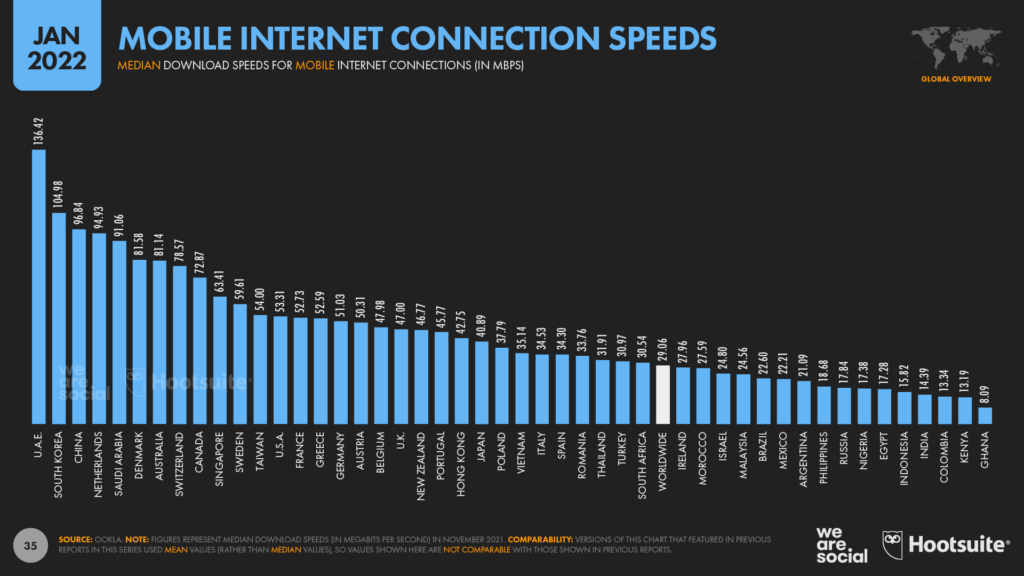
Dig deeper: read our complete analysis of mobile and fixed connections speeds by clicking here.
Related: make sense of today's mobile cyberspace mural with the assist of GSMA Intelligence'due south Country of Mobile Cyberspace Connectivity report.
Cryptocurrencies catch on
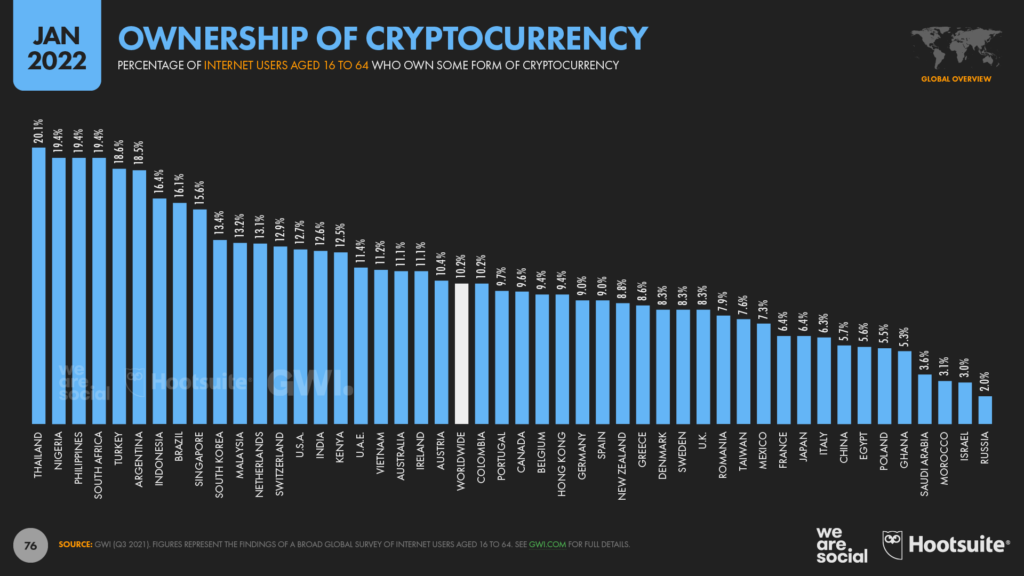
The number of people who own cryptocurrencies has jumped by more than a third (+37.8 per centum) since this time final year.
GWI reports that more than 1 in 10 working-age internet users at present owns some grade of cryptocurrency, with that figure rising to more than 2 in 10 in Thailand.
Cryptocurrencies are particularly popular beyond developing economies, peculiarly in countries where conventional currencies are more prone to big fluctuations in exchange rates.
For example, in Turkey – where the local lira has lost roughly one-half of its value versus the US dollar over the past year – ownership of cryptocurrencies has almost doubled (+86 percentage) in the past twelve months, from 10 percent to xviii.6 percent.
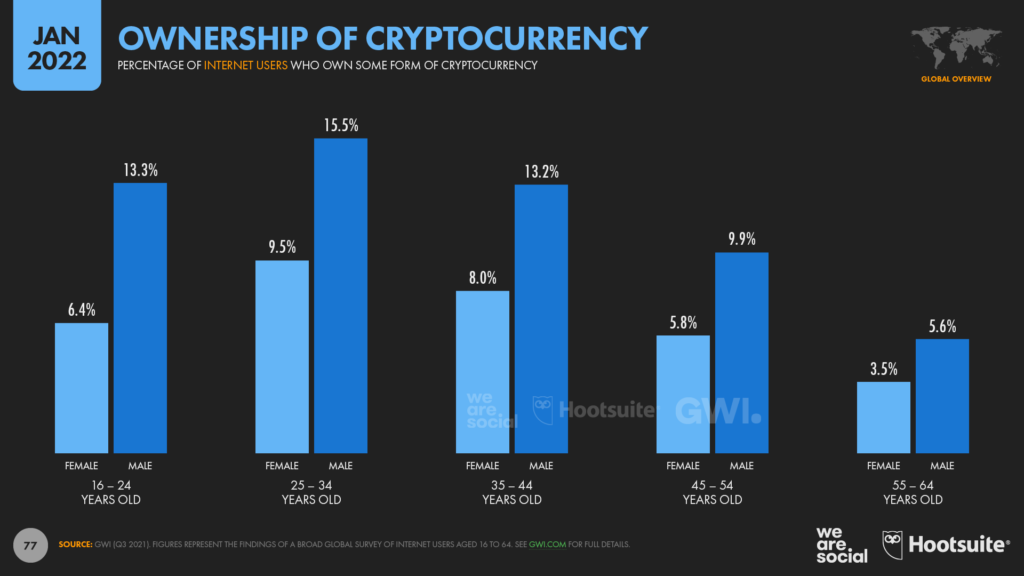
All the same, "crypto" ownership is still heavily male skewed, and older audiences are also underrepresented.
Fewer than 1 in twenty internet users aged 55 to 64 owns any cryptocurrency today, and this finding may have important implications for policy makers exploring the potential for digital currencies.
Dig deeper: acquire more virtually cryptocurrency trends in GWI's excellent Connecting the Dots written report.
Near people pay for digital content
Contrary to stereotypes, the world's cyberspace users are not averse to paying for digital content.
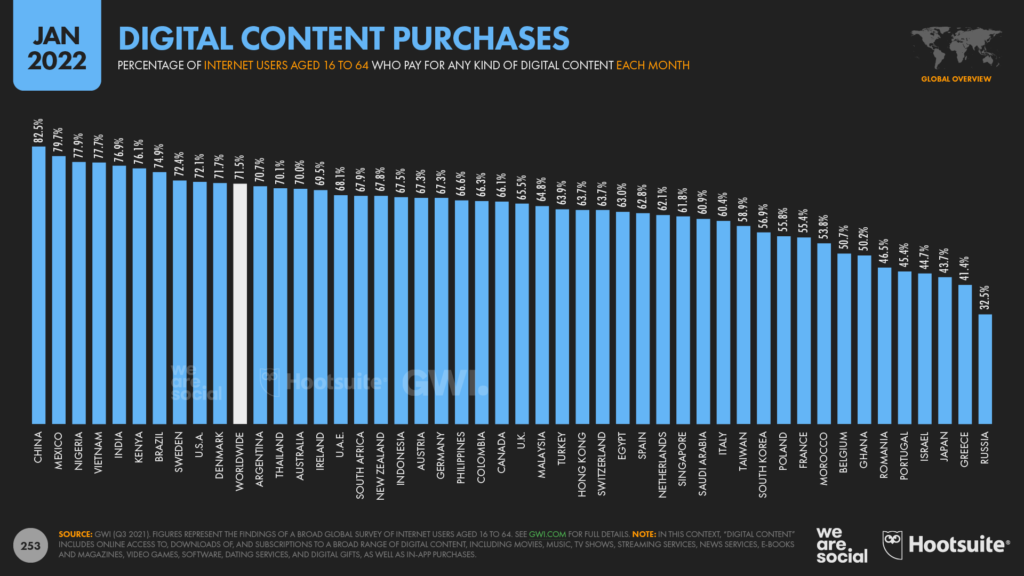
GWI finds that more than 7 in 10 working-age net users (71.5 percent) now pay for some course of digital content each month, with that figure rising to almost viii in 10 amidst younger Millennials.
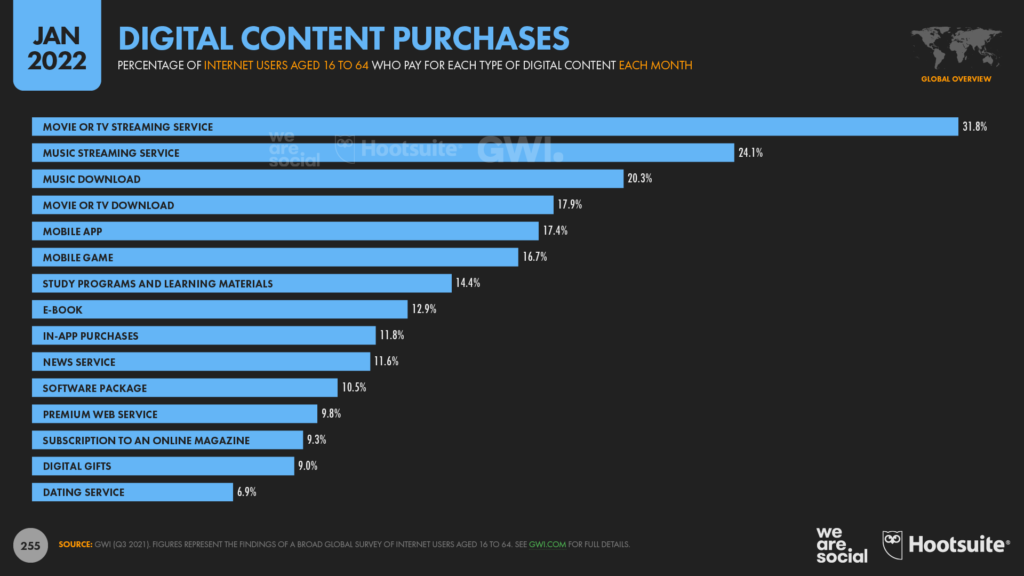
Perhaps unsurprisingly given the rapid ascent of platforms like Netflix and Spotify, Goggle box and music streaming subscriptions are the nigh popular forms of paid digital content.
However, people still pay for downloads too, with more than 1 in 5 internet users proverb that they've paid to download music within the by 30 days.
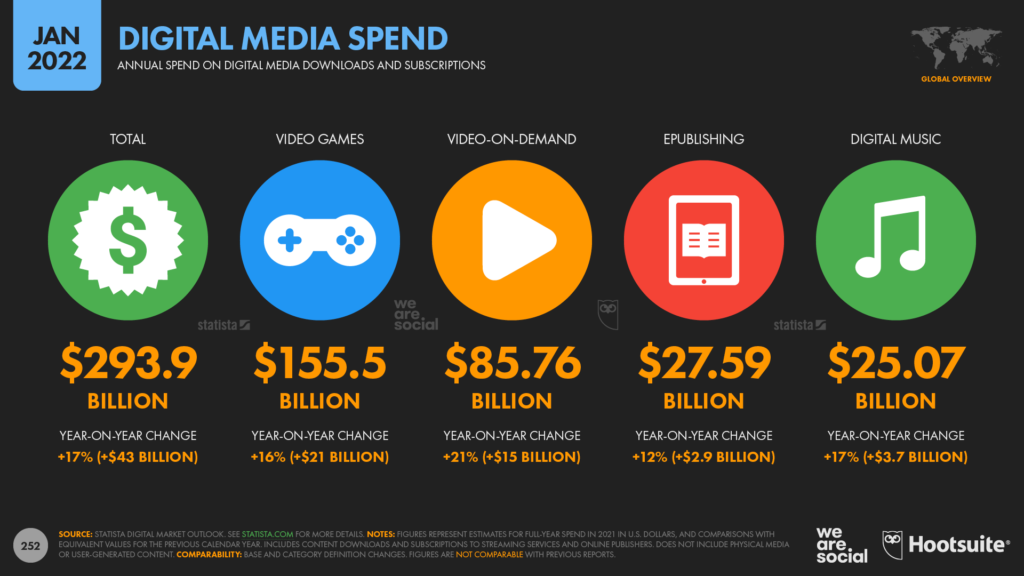
In total, Statista reports that the world's internet users spent about USD $300 billion on digital content in 2021.
Interestingly though, despite the popularity of video and music streaming platforms, spend on video games deemed for more than half of that global total, highlighting just how valuable the gaming audience remains.
Related: explore the ascent of cantankerous-cultural content in our in-depth analysis.
Looking alee: Digital 2022
That's almost all for my analysis of this year'due south Global Overview Report, but here are a few things to look out for over the coming months:
- We should pass the momentous v billion net user milestone in time for our next quarterly Statshot report. To gloat, we'll offer a bumper drove of insights into how the internet impacts daily lives around the world, so be certain to cheque back for that assay in belatedly Apr.
- We may run into some turbulence in the world of decentralised finance (DeFi) over the next few months, with the value of cryptocurrencies standing their wild swings. Moreover, with e'er more people investing in these "alternative" financial instruments, we can expect calls for greater regulation, more stringent regime oversight, and – most inevitably – new forms of taxation.
- At the aforementioned fourth dimension, while the underlying tech is undoubtedly hither to stay, people volition come to realise that NFTs are nothing more than than certificates of digital buying, and – ultimately – it'southward the assets they correspond that make up one's mind their actual value. Equally a result, I hope we'll run into the NFT conversation shift abroad from irrational speculation, and put greater emphasis on helping the world's creators derive enduring value from their difficult work.
- Following the success of Squid Game, Money Heist, and Lupin, expect the unexpected when information technology comes to digitally distributed culture. Streaming platforms brand it easier than ever for not bad content to travel effectually the world in an instant, fuelled by the social media water-cooler and ever more authentic algorithms. As a result, tomorrow'south big hits are only equally probable to come from Hanoi and Harare every bit they are to come from Hollywood.
- We'll showtime to come across greater convergence across digital activities, with formats like Live Commerce blending the best of social media, entertainment, and online shopping. Similarly, as faster mobile connections and more powerful mobile devices become ever more than attainable, nosotros can await more immersive content experiences. In particular, I'g expecting to see AR find its manner into rich music 'experiences' (well beyond music videos), while a handful of brands volition also move beyond hype and hot air to evangelize some truly compelling experiences in online virtual worlds.
Hopefully that'due south given you more than enough to retrieve almost, only just in case yous're already peckish your next fix of facts and figures, you might like to know that I'll be back in a couple of weeks with the first of our Digital 2022 local country reports, which we'll start publishing in mid-Feb.
And finally…
I suspect you've only made it this far because you're anxious to find the latest updates in 1 of our most thought-provoking datasets, so I won't leave you disappointed.
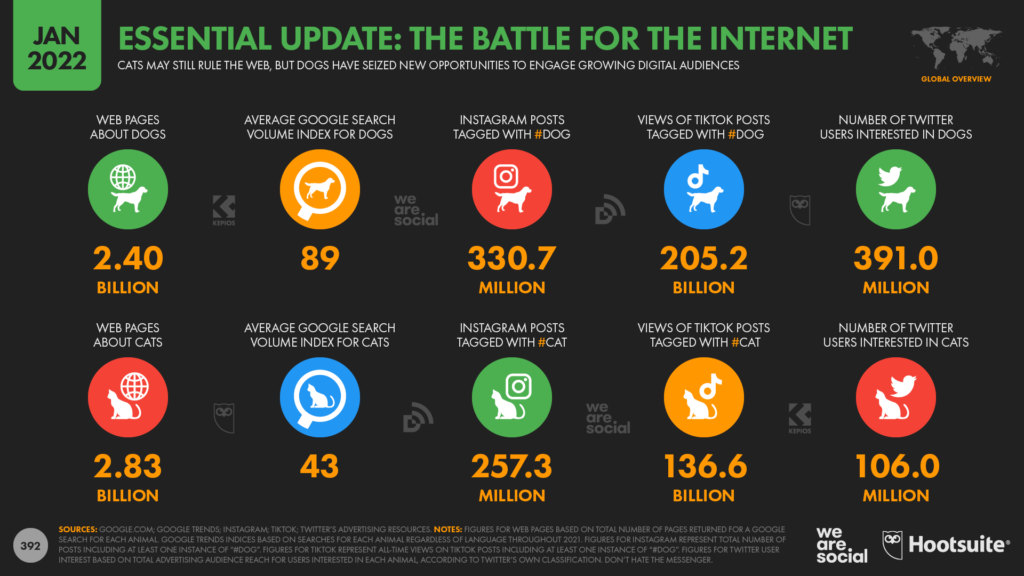
Regular readers will be pleased to hear that the battle for the net continues, but – for the tertiary yr in a row – data suggests that dogs may in one case once more have had the upper paw paw in 2021.
To date, users have published more than 330 million posts to Instagram tagged with #canis familiaris, compared with just 257 million posts tagged with #cat.
These figures reveal that Instagram has seen an impressive 38 million new #dog posts since our 2021 report, but just 27 1000000 new posts for #cat.
Still, canines' dogged success over the by twelvemonth isn't just down to the #dogsofinstagram.
A like pattern has played out on TikTok, where #dog posts now exceed 205 meg, compared to but 137 million for #true cat posts.
In a more encouraging finding for the felines, Twitter users appear to have become a niggling less extreme in their fauna views over the by year, but dog lovers nevertheless outnumber cat lovers on the platform past a factor of almost iv to 1.
Dogs are clearly more than salient in the zeitgeist besides, with Google Trends data revealing that the world'southward cyberspace users searched for dogs twice as often as they searched for cats during 2021.
However, despite these valiant canine capers, cats however rule the web: Google returns more than ii.83 billion pages for "cat" today, compared with just 2.four billion for "domestic dog".
Don't hate the messenger.
Share your thoughts
- Share via Facebook
- Share via Twitter
- Share via LinkedIn

Post a Comment for "A Quarter Past Twelve Clip Art 9 20 Digital"