Sons of Levi Do Offer Again an Offering
The Levitical Priesthood
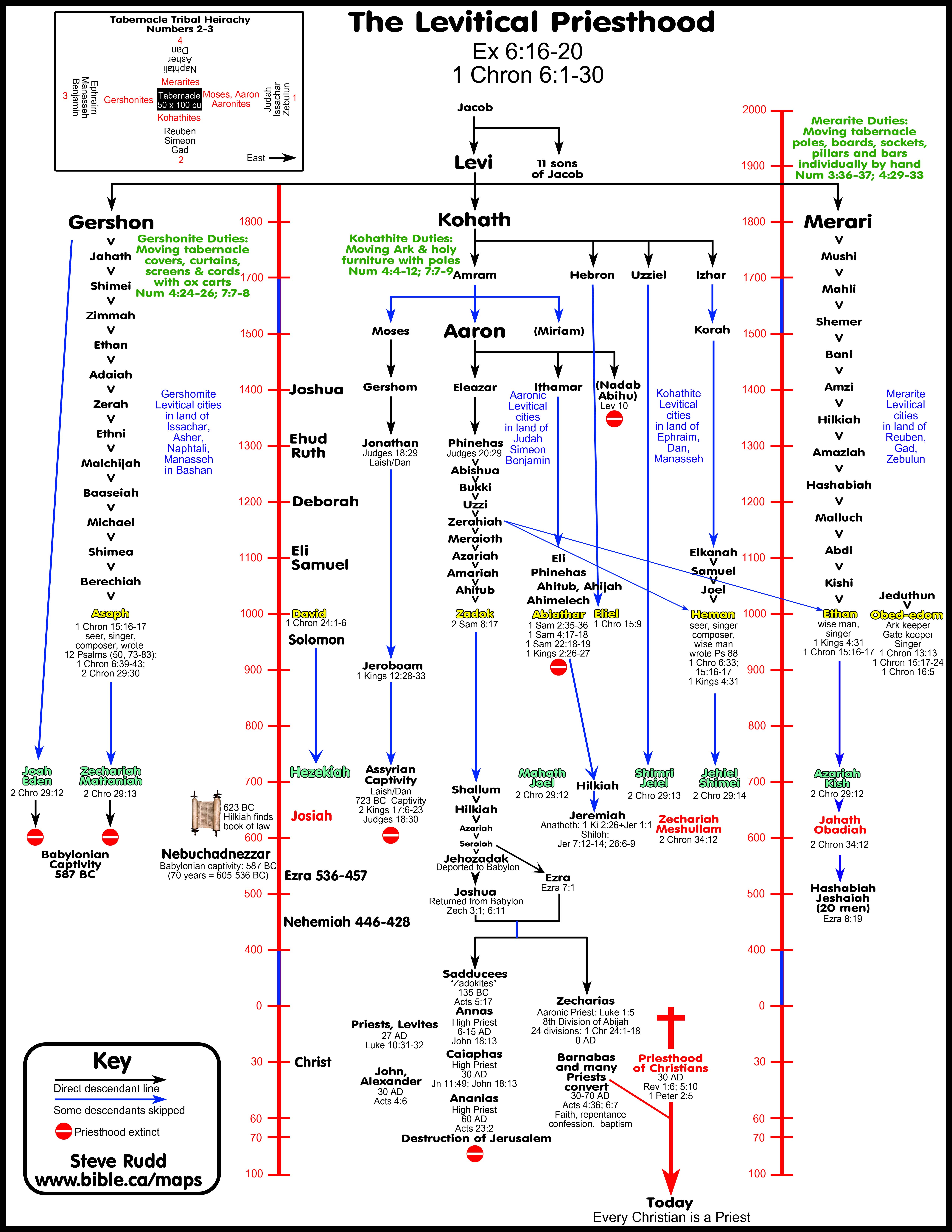
| The Levitical Priesthood The Levitical Priesthood traces through the three sons of Levi, through the Sadducees until it went extinct at the death of Christ, when information technology was replaced with the Priesthood of Christians which endures until the 2nd coming. | |
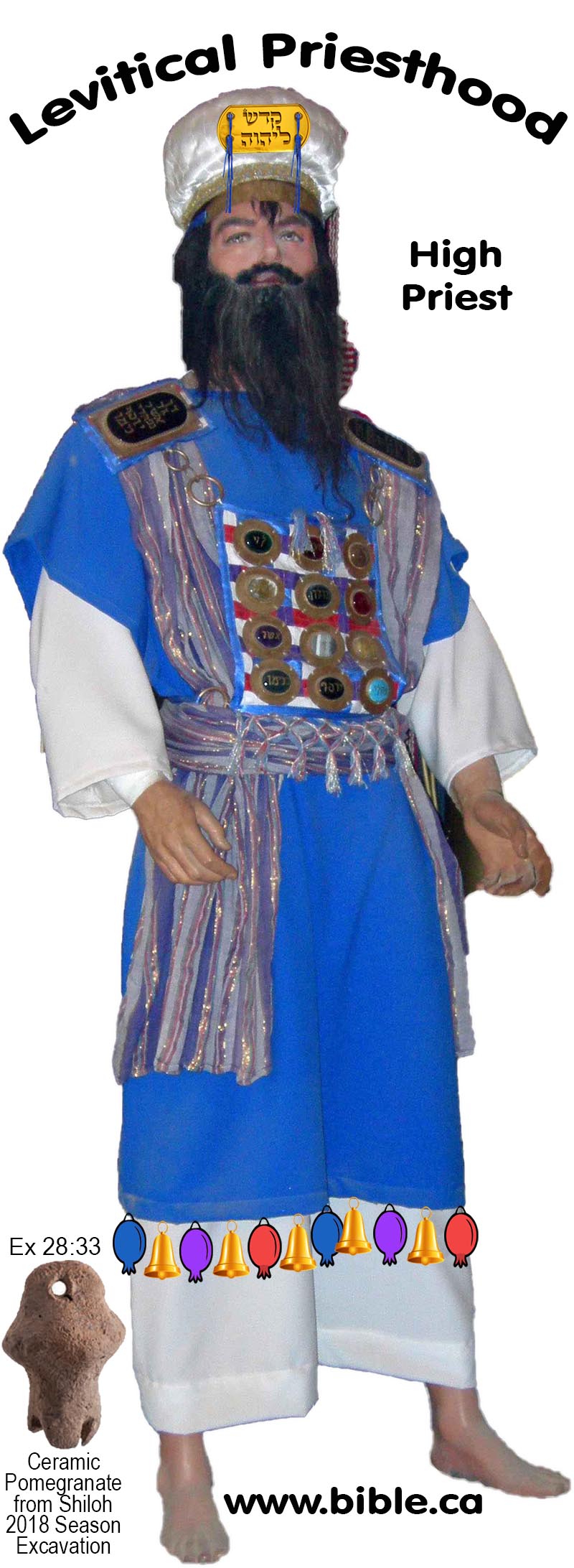
The Levitical Priesthood
Introduction:
i. The Levitical Priesthood traces through the three sons of Levi whose names are Gershon/Gershom (Gershonites/Gershomites), Kohath (Kohathites) and Merari (Merarites). Note: The Pentateuch spells Levi's firstborn "Gershon", just the book of Chronicles spells him "Gershom". Variations in proper noun spelling are common in the Bible.
two. A special place for the sons of Aaron: The Tabernacle began at Mt. Sinai in 1446 BC and it was at that time that special duties were given to each of the iii lines of priests but only the sons of Aaron could offering animal sacrifices or incense.
3. Levites seem to be assigned and located in every metropolis, not only the 48 Levitical cities. This would indicate that each urban center, whether large or minor, had a recognized Levite in charge of that city: �At present if a Levite comes from any of your towns throughout Israel where he resides, and comes whenever he desires to the place which the LORD chooses, and so he shall serve in the proper name of the LORD his God, like all his fellow Levites who stand there before the LORD.� (Deuteronomy 18:6-seven)
4. Loftier priests were appointed for life past Moses, only at the fourth dimension of Jesus were appointed annually past the Romans. This is why we take multiple loftier priests at the trial of Jesus (Annas and Caiaphas). Annas was High Priest from half dozen-fifteen Advertizement. Then from xvi-30 Advert Caiaphas was Loftier Priest. In threescore-63 AD, Ananias was the loftier priest who tried Paul in Acts 23:2.
v. The priesthood continued downwards to the destruction of Jerusalem in 70 Advertising when information technology became physically extinct, but it was rendered spiritually extinct at the death of Christ being replaced by the priesthood of believers in Christ.
six. Today, every Christian is a priest and Christ is our high priest.
A. Ceramic Pomegranate found at Shiloh archeological excavations in 2022 AD:

1. Two Pomegranates excavated at Shiloh: dating to 1100 BC:
a. 2018 AD by Associates for Biblical Research excavation squad, Object 900: �The ceramic pomegranate came, as noted above, from Locus 7 of the new excavations at Shiloh (Season 2018; Expanse H1, Sq. AH29, Field No. TL104, Pail 57; Obj. No. 900). It is made of Munsell 2.5YR 8/3 colored clay. The dimensions are: length: 43 mm, max width 29 mm, calyx width 17 mm. The object is almost complete, and its trunk is solid; it was fabricated by hand and shaped past mitt. Information technology includes a broad (17 mm) addition on top perforated for suspension (the dirt was perforated afterward firing, with a 3 mm perforation pigsty). The body of the fruit is broad and rather squat rather than spherical; the lower part is the calyx with a cylindrical shape and at its end four wide elongated petals, slightly bent inwards, cut in the clay (2 complete, 1 broken, and 1 missing). Their rather straight, wide edges are on the same airplane. The object is a suspended solid pomegranate �pendant� (see below Type 3). Possibly, the object depicts a pomegranate bud since the petals� are non open.� (A Ceramic Pomegranate from Shiloh, Tim Lopez, Scott Stripling and David Ben-Shlomo, Judea and Samaria Research Studies, Book 28, No. one, p44, 2022 AD)
b. 1920�s Danish Expedition, Object 100: �A possible pomegranate discovered by the Danish team derives from Cave S in Area F, an area south of the top with several interconnected caves (Buhl and Holm-Nielsen 1969: 25�26). Nevertheless, Cavern S has no connexion with other caves in the area. Information technology has an irregular shape, measuring approximately iii.v m from northwest to southeast, and two.3 thou from northeast to southwest. A flight of steps at the southern corner provides access to the interior of the cavern. The bottom of the cave at an top of 67.32 m is two.6 m below the surface. Excavation revealed 2 loci near the lesser of the cavern; the locus closest to the bottom measured 0.xxx m deep, and the one above it measured 0.40 m. Above these lay only Roman material. Both loci independent only Pre-Hellenistic finds. Unfortunately, the Danish excavators did not specify the exact location of each object from the cave, only they did mention that 2 flint implements (#101�102) and the possible pomegranate (#100), which they identified as a stopper (Fig. 10), emerged nigh the bottom (Buhl and Holm-Nielsen 1969: 25). The pottery associated with object #100 dates from Atomic number 26 Historic period I-II, which gives an indication of the chronology for the 2 loci closest to the lesser (Strata IV�Five) and as well for the possible pomegranate.� (A Ceramic Pomegranate from Shiloh, Tim Lopez, Scott Stripling and David Ben-Shlomo, Judea and Samaria Research Studies, Volume 28, No. ane, p46, 2022 Advertizement)
two. Pomegranate is the but fruit in the tabernacle/temple, being worn on the clothing of the high priest and later Solomon carved pomegranates on the columns of the temple.
a. Pomegranates on the hem of the Loftier Priest: 1446 BC:
i. "�Yous shall make on its hem pomegranates of blue and purple and cherry material, all around on its hem, and bells of gilt betwixt them all around: a gilded bell and a pomegranate, a gilt bong and a pomegranate, all around on the hem of the robe." (Exodus 28:33�34)
ii. "They made pomegranates of blue and regal and crimson material and twisted linen on the hem of the robe. They too fabricated bells of pure gold, and put the bells between the pomegranates all around on the hem of the robe, alternating a bell and a pomegranate all around on the hem of the robe for the service, just every bit the Lord had commanded Moses." (Exodus 39:24�26)
b. Pomegranates were a sign that the land was adept at the time of the Exodus: 1406 BC:
i. "�For the Lord your God is bringing yous into a good country, a land of brooks of water, of fountains and springs, flowing forth in valleys and hills; a country of wheat and barley, of vines and fig copse and pomegranates, a land of olive oil and honey; a land where you volition consume food without scarcity, in which you lot will not lack anything; a country whose stones are iron, and out of whose hills yous can dig copper." (Deuteronomy 8:vii�9)
ii. "And then they went up and spied out the land from the wilderness of Zin every bit far every bit Rehob, at Lebo-hamath. When they had gone upward into the Negev, they came to Hebron where Ahiman, Sheshai and Talmai, the descendants of Anak were. (Now Hebron was built seven years before Zoan in Arab republic of egypt.) Then they came to the valley of Eshcol and from there cutting down a branch with a single cluster of grapes; and they carried it on a pole between two men, with some of the pomegranates and the figs. That place was called the valley of Eshcol, considering of the cluster which the sons of State of israel cut down from there." (Numbers 13:21�24)
c. Pomegranates on the columns of Solomon�s temple destroyed by Nebuchadnezzar in 587 BC:
i. "He fabricated chains in the inner sanctuary and placed them on the tops of the pillars; and he fabricated 1 hundred pomegranates and placed them on the chains. He erected the pillars in front of the temple, ane on the right and the other on the left, and named the one on the right Jachin and the one on the left Boaz." (2 Chronicles three:16�17)
ii. "Now Hiram made the basins and the shovels and the bowls. And then Hiram finished doing all the work which he performed for King Solomon in the house of the Lord: the two pillars and the two bowls of the capitals which were on the top of the two pillars, and the two networks to cover the two bowls of the capitals which were on the top of the pillars; and the four hundred pomegranates for the 2 networks, two rows of pomegranates for each network to cover the two bowls of the capitals which were on the tops of the pillars;" (1 Kings 7:twoscore�42)
iii. "And then he made the pillars, and 2 rows around on the one network to encompass the capitals which were on the top of the pomegranates; and then he did for the other uppercase. The capitals which were on the pinnacle of the pillars in the porch were of lily pattern, four cubits. There were capitals on the two pillars, even above and close to the rounded project which was abreast the network; and the pomegranates numbered two hundred in rows around both capitals." (1 Kings vii:eighteen�twenty)
4. "Now the bronze pillars which were in the house of the Lord, and the stands and the bronze sea which were in the house of the Lord, the Chaldeans broke in pieces and carried the bronze to Babylon. They took away the pots, the shovels, the snuffers, the spoons, and all the bronze vessels which were used in temple service. The captain of the guard also took abroad the firepans and the basins, what was fine gold and what was fine silver. The two pillars, the 1 bounding main, and the stands which Solomon had made for the house of the Lord�the bronze of all these vessels was across weight. The height of the one pillar was xviii cubits, and a bronze capital was on it; the height of the capital was three cubits, with a network and pomegranates on the capital letter all around, all of bronze. And the 2nd pillar was like these with network." (2 Kings 25:13�17)
3. Contrary to popular Jewish Myth, pomegranates do not accept 613 seeds, one for each of the 613 commandments in the Torah.
a. FACT Cheque: At that place are Non 613 seeds in a pomegranate.
b. At that place are around 454 seeds in a pomegranate.
c. At that place are far less than 613 commandments in the Torah
d. This myth came from a 4thursday century Advertizement sermon past a Jewish Rabbi which was adopted equally truth.
B. The three sons of Levi: Gershon, Kohath, Merari
1. Gershonites: (descendants of Gershon/Gershon, offset son of Levi)
a. The Gershonites camped on the due west side of the tabernacle: �The families of the Gershonites were to army camp behind the tabernacle westward� (Numbers 3:23)
b. Their duties: Moving tabernacle covers, curtains, screens & cords with ox carts: Num 4:24-26; 7:7-8
1. "Now the duties of the sons of Gershon in the tent of meeting involved the tabernacle and the tent, its covering, and the screen for the doorway of the tent of meeting, and the hangings of the court, and the screen for the doorway of the court which is effectually the tabernacle and the altar, and its cords, according to all the service concerning them." (Numbers 3:25-26)
two. ""This is the service of the families of the Gershonites, in serving and in conveying: they shall carry the curtains of the tabernacle and the tent of coming together with its roofing and the covering of porpoise skin that is on top of it, and the screen for the doorway of the tent of meeting, and the hangings of the courtroom, and the screen for the doorway of the gate of the courtroom which is effectually the tabernacle and the altar, and their cords and all the equipment for their service; and all that is to be done, they shall perform." (Numbers 4:24-26)
c. The Gershonites got two carts:
ane. "Two carts and four oxen he gave to the sons of Gershon, co-ordinate to their service, and four carts and eight oxen he gave to the sons of Merari, according to their service, under the management of Ithamar the son of Aaron the priest. Only he did not give any to the sons of Kohath because theirs was the service of the holy objects, which they carried on the shoulder." (Numbers vii:7-9)
d. The 13 Levitical cities of the Gershonites:
1. Located within Issachar, Asher, Naphtali, Manasseh in Bashan
2. "The sons of Gershon received thirteen cities by lot from the families of the tribe of Issachar and from the tribe of Asher and from the tribe of Naphtali and from the one-half-tribe of Manasseh in Bashan." (Joshua 21:six)
2. Kohathites: (descendants of Kohath, second son of Levi, Aaron and Moses were Kohathites but had special rank)
a. The Kohathites camped on the southward side of the tabernacle: Numbers 3:29
b. Duties: holy items similar conveying the Ark of the Covenant, the lampstand, altars, utensils with poles:
1. "The families of the sons of Kohath were to camp on the southward side of the tabernacle, and the leader of the fathers' households of the Kohathite families was Elizaphan the son of Uzziel. Now their duties involved the ark, the table, the lampstand, the altars, and the utensils of the sanctuary with which they government minister, and the screen, and all the service concerning them; and Eleazar the son of Aaron the priest was the chief of the leaders of Levi, and had the oversight of those who perform the duties of the sanctuary." (Numbers 3:29-32)
2. Although the Kohathites were entrusted specifically with moving the Ark, David used the priests from Gershon, Merarites and Merari to motion the Ark from the business firm of Obed-edom afterwards Uzzah died in the beginning attempt: (1 Chronicles 15:1-15)
a. "Now David built houses for himself in the city of David; and he prepared a identify for the ark of God and pitched a tent for it. Then David said, "No 1 is to behave the ark of God but the Levites; for the LORD chose them to carry the ark of God and to minister to Him forever." And David assembled all Israel at Jerusalem to bring up the ark of the LORD to its identify which he had prepared for information technology. David gathered together the sons of Aaron and the Levites: of the sons of Kohath, Uriel the master, and 120 of his relatives; of the sons of Merari, Asaiah the chief, and 220 of his relatives; of the sons of Gershon, Joel the primary, and 130 of his relatives; of the sons of Elizaphan, Shemaiah the chief, and 200 of his relatives; of the sons of Hebron, Eliel the principal, and 80 of his relatives; of the sons of Uzziel, Amminadab the principal, and 112 of his relatives. Then David called for Zadok and Abiathar the priests, and for the Levites, for Uriel, Asaiah, Joel, Shemaiah, Eliel and Amminadab, and said to them, "You are the heads of the fathers' households of the Levites; consecrate yourselves both y'all and your relatives, that you may bring upwards the ark of the LORD God of Israel to the place that I take prepared for it. "Considering yous did not carry it at the first, the LORD our God made an outburst on us, for we did not seek Him according to the ordinance." And then the priests and the Levites consecrated themselves to bring up the ark of the LORD God of Israel. The sons of the Levites carried the ark of God on their shoulders with the poles thereon, equally Moses had commanded according to the word of the LORD." (1 Chronicles xv:1-15)
c. The Kohathites got no carts simply had to carry all the holy objects of furniture on poles and carrying confined:
i. The Kohathites did non get any carts like the Gershonites and the Merarites because they were exclusively entrusted with these holy items.
2. "Two carts and four oxen he gave to the sons of Gershon, according to their service, and 4 carts and eight oxen he gave to the sons of Merari, according to their service, under the management of Ithamar the son of Aaron the priest. Only he did not give whatever to the sons of Kohath considering theirs was the service of the holy objects, which they carried on the shoulder." (Numbers 7:vii-ix)
three. "This is the work of the descendants of Kohath in the tent of coming together, apropos the almost holy things. �When the military camp sets out, Aaron and his sons shall go in and they shall take downward the veil of the screen and cover the ark of the testimony with it; and they shall lay a roofing of porpoise pare on it, and shall spread over it a cloth of pure blue, and shall insert its poles. �Over the tabular array of the breadstuff of the Presence they shall also spread a textile of blueish and put on it the dishes and the pans and the sacrificial bowls and the jars for the drink offering, and the continual bread shall exist on it. �They shall spread over them a cloth of red material, and comprehend the same with a roofing of porpoise peel, and they shall insert its poles. �And then they shall have a blue cloth and cover the lampstand for the calorie-free, along with its lamps and its snuffers, and its trays and all its oil vessels, by which they serve information technology; and they shall put it and all its utensils in a covering of porpoise skin, and shall put it on the carrying bars. �Over the golden altar they shall spread a bluish textile and comprehend it with a covering of porpoise skin, and shall insert its poles; and they shall take all the utensils of service, with which they serve in the sanctuary, and put them in a blue material and encompass them with a covering of porpoise skin, and put them on the conveying bars.� (Numbers 4:4�12)
d. The 23 Levitical cities of the Kohathites:
i. Located in Ephraim, Dan, Manasseh in Canaan
2. "And then the lot came out for the families of the Kohathites. And the sons of Aaron the priest, who were of the Levites, received thirteen cities by lot from the tribe of Judah and from the tribe of the Simeonites and from the tribe of Benjamin. The rest of the sons of Kohath received x cities past lot from the families of the tribe of Ephraim and from the tribe of Dan and from the half-tribe of Manasseh." (Joshua 21:4-5)
3. Merarites: (descendants of Merari, third son of Levi)
a. Merarites camped on the northward side of the tabernacle: Numbers 3:33-37
b. Their duties: Moving tabernacle poles, boards, sockets, pillars and bars past mitt. Each item is assigned individually to a homo who carries it with his bare hands: Num iii:36-37; 4:29-33
ane. "The Levites, all the same, were not numbered amongst them by their fathers' tribe. For the LORD had spoken to Moses, saying, "Only the tribe of Levi you shall not number, nor shall you take their demography amongst the sons of Israel. "But yous shall appoint the Levites over the tabernacle of the testimony, and over all its furnishings and over all that belongs to information technology. They shall behave the tabernacle and all its furnishings, and they shall take care of it; they shall as well camp around the tabernacle. "And then when the tabernacle is to set out, the Levites shall take it downwardly; and when the tabernacle encamps, the Levites shall set it up. Simply the layman who comes well-nigh shall be put to decease. "The sons of State of israel shall camp, each homo by his own camp, and each man past his own standard, according to their armies. "Merely the Levites shall camp effectually the tabernacle of the testimony, so that in that location volition be no wrath on the congregation of the sons of Israel. And then the Levites shall go along accuse of the tabernacle of the testimony."" (Numbers 1:47-53)
2. "Of Merari was the family of the Mahlites and the family of the Mushites; these were the families of Merari. Their numbered men in the numbering of every male from a calendar month old and upward, were six,200. The leader of the fathers' households of the families of Merari was Zuriel the son of Abihail. They were to campsite on the northward side of the tabernacle. Now the appointed duties of the sons of Merari involved the frames of the tabernacle, its bars, its pillars, its sockets, all its equipment, and the service concerning them, and the pillars around the court with their sockets and their pegs and their cords." (Numbers 3:33-37)
3. "As for the sons of Merari, you shall number them past their families, by their fathers' households; from thirty years and upward even to 50 years onetime, you shall number them, everyone who enters the service to practice the work of the tent of coming together. "Now this is the duty of their loads, for all their service in the tent of coming together: the boards of the tabernacle and its confined and its pillars and its sockets, and the pillars around the court and their sockets and their pegs and their cords, with all their equipment and with all their service; and yous shall assign each homo by proper noun the items he is to carry. "This is the service of the families of the sons of Merari, according to all their service in the tent of meeting, nether the management of Ithamar the son of Aaron the priest." (Numbers 4:29-33)
c. The 12 Levitical cities:
1. Located within Reuben, Gad, and Zebulun
2. "The sons of Merari co-ordinate to their families received twelve cities from the tribe of Reuben and from the tribe of Gad and from the tribe of Zebulun." (Joshua 21:7)
3. "To the families of the sons of Merari, the rest of the Levites, they gave from the tribe of Zebulun, Jokneam with its pasture lands and Kartah with its pasture lands. Dimnah with its pasture lands, Nahalal with its pasture lands; four cities. From the tribe of Reuben, they gave Bezer with its pasture lands and Jahaz with its pasture lands, Kedemoth with its pasture lands and Mephaath with its pasture lands; four cities. From the tribe of Gad, they gave Ramoth in Gilead, the city of refuge for the manslayer, with its pasture lands and Mahanaim with its pasture lands, Heshbon with its pasture lands, Jazer with its pasture lands; four cities in all. All these were the cities of the sons of Merari co-ordinate to their families, the rest of the families of the Levites; and their lot was twelve cities." (Joshua 21:34-40)
iv. Aaronites: (descendants of Aaron and Moses)
a. Aaron and Moses were sons of Kohath, the second son of Levi, only had special pre-eminence over all others
i. Moses is called a priest in Ps 99:6
b. Aaronites camped on the east side of the tabernacle. The due east side was the entrance to the Tabernacle and the nearly of import surface area. This was where Aaron and Moses camped. They accept front and middle prominence: �Now those who were to camp before the tabernacle eastward, before the tent of coming together toward the sunrise, are Moses and Aaron and his sons, performing the duties of the sanctuary for the obligation of the sons of Israel; simply the layman coming well-nigh was to exist put to decease.� (Numbers iii:38)
c. Special duties of the Aaronites:
i. A special identify for the sons of Aaron: The Tabernacle began at Mt. Sinai in 1446 BC and information technology was at that fourth dimension that special duties were given to each of the iii lines of priests.
ii. It is important to notice that only the Aaronic priests (Aaron and his sons) were permitted to offer animal sacrifices in the Tabernacle or offer the incense. Only they had access to the Holy and Most holy place of the tabernacle in service.
d. The rebellion of Korah at Sinai in Numbers was a claiming of the other two priest lines against this exclusive right that Aaronites had over them and it cost them their lives: �So Eleazar the priest took the statuary censers which the men who were burned had offered, and they hammered them out equally a plating for the altar, as a reminder to the sons of State of israel that no layman who is not of the descendants of Aaron should come nigh to burn incense earlier the LORD; so that he volition not become similar Korah and his company�just every bit the LORD had spoken to him through Moses.� (Numbers 16:39�40)
v. Moses as a priest: (descendants of Kohath)
a. Aaron and Moses were sons of Kohath, the 2nd son of Levi, but had special pre-eminence over all others
b. Moses was called a priest: �Moses and Aaron were among His priests, And Samuel was among those who called on His proper name; They chosen upon the LORD and He answered them.� (Psalm 99:six)
c. Moses functioned every bit a priest on three occasions, all before the priesthood was consecrated to serve "later on the order of Aaron."
a. Ex 24, when he sprinkled the book and the people at the ratification of the Law
b. Ex 40:22f, when he ready up the tabernacle, put bread on the table, burned incense on the chantry of incense, and offered a burnt offering and repast offering on the chantry of burnt offering
c. Lev 8, when he all-powerful the tabernacle and all that was in it, the priests, and offered a sin offering, a burnt offering and an ordination offering for the consecration of the priests.
d. After that priests must be "after the order of Aaron," Heb 7:eleven.
d. Why Moses is called a priest in Ps 99:6 may be a thing a special privilege since he functioned equally HIGH priest before Aaron got his exclusive rights. It really should not surprise usa. Why would he LOSE this power and position when he appointed Aaron? I call back the answer is that he did not. Moses must accept been a total priest forever, simply thereafter Aaron's sons were the chosen ones.
e. It is interesting that Jonathan in 1300 BC was a son of Moses and functioned as a priest. �The sons of Dan set for themselves the graven image; and Jonathan, the son of Gershon, the son of Moses, he and his sons were priests to the tribe of the Danites until the twenty-four hours of the captivity of the land.� (Judges xviii:30) This Jonathan was in fact responsible for the paganism and idolatry that eventually sent the Danites in Laish (Dan) and the 10 tribes into extinction in 722 BC.
C. David reorganizes the priesthood in chiliad BC
1. When King David designed the temple, had all the stones precut and ready for Solomon to build it without a cutting tool, he also reorganized the priesthood into 24 divisions. These 24 divisions continued downward to the time of Christ.
a. "Now the divisions of the descendants of Aaron were these: the sons of Aaron were Nadab, Abihu, Eleazar and Ithamar. Simply Nadab and Abihu died before their father and had no sons. And so Eleazar and Ithamar served every bit priests. David, with Zadok of the sons of Eleazar and Ahimelech of the sons of Ithamar, divided them co-ordinate to their offices for their ministry. Since more chief men were found from the descendants of Eleazar than the descendants of Ithamar, they divided them thus: there were sixteen heads of fathers' households of the descendants of Eleazar and 8 of the descendants of Ithamar, according to their fathers' households. Thus they were divided by lot, the one every bit the other; for they were officers of the sanctuary and officers of God, both from the descendants of Eleazar and the descendants of Ithamar. Shemaiah, the son of Nethanel the scribe, from the Levites, recorded them in the presence of the rex, the princes, Zadok the priest, Ahimelech the son of Abiathar, and the heads of the fathers' households of the priests and of the Levites; one begetter'south household taken for Eleazar and one taken for Ithamar." (one Chronicles 24:1-six)
two. David's high priest was Abiathar, but because of insurrection he was replaced past Solomon with Zadok as loftier priest. This was to fulfill the prophecy that the priesthood of Eli (Aaron's son Ithamar) would go extinct, showtime in the decease of Eli and his two sons, then second when Saul killed all the priests at Nob when David ate the holy bread of the temple.
a. "'But I volition raise upward for Myself a faithful priest who will do according to what is in My eye and in My soul; and I will build him an enduring house, and he will walk before My anointed e'er. 'Everyone who is left in your house volition come and bow downwards to him for a slice of silver or a loaf of staff of life and say, "Please assign me to one of the priest's offices so that I may consume a piece of bread." ' "" (one Samuel 2:35-36)
b. "Then the one who brought the news replied, "Israel has fled before the Philistines and there has too been a great slaughter among the people, and your two sons as well, Hophni and Phinehas, are dead, and the ark of God has been taken." When he mentioned the ark of God, Eli vicious off the seat backward beside the gate, and his neck was broken and he died, for he was one-time and heavy. Thus he judged Israel 40 years." (1 Samuel 4:17-xviii)
c. "Then the king said to Doeg, "You lot turn around and attack the priests." And Doeg the Edomite turned effectually and attacked the priests, and he killed that day lxxx-five men who wore the linen ephod. And he struck Nob the city of the priests with the edge of the sword, both men and women, children and infants; as well oxen, donkeys, and sheep he struck with the edge of the sword." (one Samuel 22:18-19)
d. "And then to Abiathar the priest the king said, "Go to Anathoth to your own field, for you lot deserve to dice; but I will not put y'all to expiry at this time, because y'all carried the ark of the Lord God before my male parent David, and because you were afflicted in everything with which my father was affected." And so Solomon dismissed Abiathar from being priest to the Lord, in order to fulfill the discussion of the Lord, which He had spoken concerning the firm of Eli in Shiloh." (1 Kings 2:26-27)
e. "The king (Solomon) appointed Benaiah the son of Jehoiada over the army in his place, and the rex appointed Zadok the priest in the place of Abiathar." (1 Kings 2:35)
3. Zadok, Solomon's high priest, was a descendant of Levi's second son Kohath.
a. The idea of a "Zadok" or Zakokite priesthood is an educated gauge.
i. From the time of David down to 70 Ad it were the descendants of Zadok who were often the high priests.
two. There is, all the same, piddling data about the high priests after the return from Babylon.
b. "Zadok the son of Ahitub and Ahimelech the son of Abiathar were priests, and Seraiah was secretarial assistant." (2 Samuel 8:17)
c. The Sadducees have their origin in about 150 BC.
i. The discussion Sadducee is etymologically linked to Zadok (Kohathite), who was David's priest.
ii. The Sadducees controlled the Temple of Herod when Jesus was alive.
4. David's key spiritual men were:
a. Abiathar, who was loftier priest and was replaced past Zadok past Solomon after David died. (come across above)
b. Zadok, who was a cardinal priest of David promoted to high priest by Solomon.
c. David relied upon Asaph, the seer, in music and psalms composition:
i. Asaph was a descendant of Gershon: "Heman's blood brother Asaph stood at his right hand, even Asaph the son of Berechiah, the son of Shimea, the son of Michael, the son of Baaseiah, the son of Malchijah, the son of Ethni, the son of Zerah, the son of Adaiah, the son of Ethan, the son of Zimmah, the son of Shimei, the son of Jahath, the son of Gershon, the son of Levi." (one Chronicles vi:39-43)
2. Asaph, a Gershonite was a prophet (seer), singer, music composer and he wrote 12 Psalms (l, 73-83):
iii. "Moreover, Rex Hezekiah and the officials ordered the Levites to sing praises to the Lord with the words of David and Asaph the seer. So they sang praises with joy, and bowed downward and worshiped." (ii Chronicles 29:xxx)
a. "For in the days of David and Asaph, in aboriginal times, there were leaders of the singers, songs of praise and hymns of thanksgiving to God." (Nehemiah 12:46)
b. "So David spoke to the chiefs of the Levites to appoint their relatives the singers, with instruments of music, harps, lyres, loud-sounding cymbals, to raise sounds of joy. So the Levites appointed Heman the son of Joel, and from his relatives, Asaph the son of Berechiah; and from the sons of Merari their relatives, Ethan the son of Kushaiah," (1 Chronicles 15:16-17)
c. "Heman's blood brother Asaph stood at his right hand, even Asaph the son of Berechiah, the son of Shimea, the son of Michael, the son of Baaseiah, the son of Malchijah, the son of Ethni, the son of Zerah, the son of Adaiah, the son of Ethan, the son of Zimmah, the son of Shimei, the son of Jahath, the son of Gershon, the son of Levi." (1 Chronicles 6:39-43)
d. "Moreover, King Hezekiah and the officials ordered the Levites to sing praises to the Lord with the words of David and Asaph the seer. So they sang praises with joy, and bowed down and worshiped." (two Chronicles 29:30)
iv. "So David spoke to the chiefs of the Levites to engage their relatives the singers, with instruments of music, harps, lyres, loud-sounding cymbals, to raise sounds of joy. And so the Levites appointed Heman the son of Joel, and from his relatives, Asaph the son of Berechiah; and from the sons of Merari their relatives, Ethan the son of Kushaiah," (1 Chronicles 15:16-17)
d. David used Heman (Kohathite) as a wise man, prophet (seer), temple vocalizer, music composer and author of Ps 88:
i. Heman was a Kohathite through Izhar, Korah (who got killed at Kadesh Barnea for rebellion when the world opened upwards and swallowed him), and was the grandson of the prophet Samuel.
ane. "These are those who served with their sons: From the sons of the Kohathites were Heman the vocalist, the son of Joel, the son of Samuel," (1 Chronicles 6:33)
ii. "The sons of Zerah were Zimri, Ethan, Heman, Calcol and Dara; five of them in all." (1 Chronicles 2:6)
3. "and Uzzi became the father of Zerahiah, and Zerahiah became the father of Meraioth, Meraioth became the father of Amariah, and Amariah became the father of Ahitub, and Ahitub became the male parent of Zadok, and Zadok became the father of Ahimaaz," (1 Chronicles 6:6-8)
4. Either in that location are two Hemans or he was descended from 2 branches of the Koathites who intermarried in the past: Zerahiah (Aaron) and Samuel the prophet via Izhar (Kohath)
2. Detect that Heman was the second man who came to listen when thinking of the wisest men compared to Solomon!
1. "For he was wiser than all men, than Ethan the Ezrahite, Heman, Calcol and Darda, the sons of Mahol; and his fame was known in all the surrounding nations." (ane Kings 4:31)
three. Heman was a singer, musician and composer of music:
ane. "Then David spoke to the chiefs of the Levites to appoint their relatives the singers, with instruments of music, harps, lyres, loud-sounding cymbals, to raise sounds of joy. So the Levites appointed Heman the son of Joel, and from his relatives, Asaph the son of Berechiah; and from the sons of Merari their relatives, Ethan the son of Kushaiah," (1 Chronicles 15:16-17)
2. "With them were Heman and Jeduthun, and the rest who were chosen, who were designated by proper noun, to requite thank you to the LORD, considering His lovingkindness is everlasting. And with them were Heman and Jeduthun with trumpets and cymbals for those who should sound aloud, and with instruments for the songs of God, and the sons of Jeduthun for the gate. And then all the people departed each to his house, and David returned to bless his household." (1 Chronicles sixteen:41-43)
3. "Moreover, David and the commanders of the army set apart for the service some of the sons of Asaph and of Heman and of Jeduthun, who were to prophesy with lyres, harps and cymbals; and the number of those who performed their service was: Of the sons of Asaph: Zaccur, Joseph, Nethaniah and Asharelah; the sons of Asaph were under the direction of Asaph, who prophesied under the direction of the king. Of Jeduthun, the sons of Jeduthun: Gedaliah, Zeri, Jeshaiah, Shimei, Hashabiah and Mattithiah, six, nether the direction of their begetter Jeduthun with the harp, who prophesied in giving thank you and praising the LORD. Of Heman, the sons of Heman: Bukkiah, Mattaniah, Uzziel, Shebuel and Jerimoth, Hananiah, Hanani, Eliathah, Giddalti and Romamti-ezer, Joshbekashah, Mallothi, Hothir, Mahazioth. All these were the sons of Heman the king'due south seer to exalt him co-ordinate to the words of God, for God gave fourteen sons and iii daughters to Heman. All these were nether the management of their father to sing in the firm of the LORD, with cymbals, harps and lyres, for the service of the house of God. Asaph, Jeduthun and Heman were nether the direction of the king. Their number who were trained in singing to the LORD, with their relatives, all who were expert, was 288. They cast lots for their duties, all alike, the small-scale as well equally the great, the teacher as well as the pupil." (one Chronicles 25:one-8)
iv. Heman wrote Ps 88
i. "A Song. A Psalm of the sons of Korah. For the choir director; according to Mahalath Leannoth. A Maskil of Heman the Ezrahite. O Lord, the God of my salvation, I have cried out by day and in the night before You." (Psalm 88:championship-1)
e. David used Ethan, known as the adjacent wisest human after Solomon.
i. Ethan was a wise man, and also a vocalizer and musician.
ane. "For he was wiser than all men, than Ethan the Ezrahite, Heman, Calcol and Darda, the sons of Mahol; and his fame was known in all the surrounding nations." (1 Kings 4:31)
ii. "And then David spoke to the chiefs of the Levites to appoint their relatives the singers, with instruments of music, harps, lyres, loud-sounding cymbals, to raise sounds of joy. And so the Levites appointed Heman the son of Joel, and from his relatives, Asaph the son of Berechiah; and from the sons of Merari their relatives, Ethan the son of Kushaiah," (i Chronicles 15:xvi-17)
ii. Who was Ethan descended from?
one. The descendant of Zerah: "The sons of Zerah were Zimri, Ethan, Heman, Calcol and Dara; five of them in all." (1 Chronicles 2:6)
a. "and Uzzi became the father of Zerahiah [Zerah], and Zerahiah became the begetter of Meraioth, Meraioth became the father of Amariah, and Amariah became the father of Ahitub, and Ahitub became the father of Zadok, and Zadok became the father of Ahimaaz," (1 Chronicles half dozen:6-8)
ii. The son of Marari: "Then David spoke to the chiefs of the Levites to appoint their relatives the singers, with instruments of music, harps, lyres, loud-sounding cymbals, to raise sounds of joy. So the Levites appointed Heman the son of Joel, and from his relatives, Asaph the son of Berechiah; and from the sons of Merari their relatives, Ethan the son of Kushaiah," (1 Chronicles 15:16-17)
3. Either there are two Ethans or he was descended from two branches of the Levi who intermarried in the past: Zerahiah (Aaron/Kohathite) and the Merarites ( 1 Chron 15:16-17).
iv. At that place is no reason why a priest could be descended from all three sons of Levi through intermarriage and this solves the puzzle of their identity.
5. David used the Gershonites to serve in the temple, guarding the treasury:
a. "David divided them into divisions co-ordinate to the sons of Levi: Gershon, Kohath, and Merari. Of the Gershonites were Ladan and Shimei. The sons of Ladan were Jehiel the offset and Zetham and Joel, three. The sons of Shimei were Shelomoth and Haziel and Haran, iii. These were the heads of the fathers' households of Ladan. The sons of Shimei were Jahath, Zina, Jeush and Beriah. These four were the sons of Shimei. Jahath was the first and Zizah the second; but Jeush and Beriah did not have many sons, so they became a male parent's household, one class." (one Chronicles 23:half-dozen-11)
b. "The Levites, their relatives, had charge of the treasures of the business firm of God and of the treasures of the dedicated gifts. The sons of Ladan, the sons of the Gershonites belonging to Ladan, namely, the Jehielites, were the heads of the fathers' households, belonging to Ladan the Gershonite. The sons of Jehieli, Zetham and Joel his brother, had accuse of the treasures of the house of the Lord." (1 Chronicles 26:xx-22)
six. David used the priests from Gershon, Merarites and Merari to movement the Ark from the house of Obed-edom after Uzzah died in the first effort: (one Chronicles 15:1-15)
a. "Then David spoke to the chiefs of the Levites to appoint their relatives the singers, with instruments of music, harps, lyres, loud-sounding cymbals, to raise sounds of joy. So the Levites appointed Heman the son of Joel, and from his relatives, Asaph the son of Berechiah; and from the sons of Merari their relatives, Ethan the son of Kushaiah, and with them their relatives of the second rank, Zechariah, Ben, Jaaziel, Shemiramoth, Jehiel, Unni, Eliab, Benaiah, Maaseiah, Mattithiah, Eliphelehu, Mikneiah, Obed-edom and Jeiel, the gatekeepers. So the singers, Heman, Asaph and Ethan were appointed to sound aloud cymbals of statuary; and Zechariah, Aziel, Shemiramoth, Jehiel, Unni, Eliab, Maaseiah and Benaiah, with harps tuned to alamoth; and Mattithiah, Eliphelehu, Mikneiah, Obed-edom, Jeiel and Azaziah, to lead with lyres tuned to the sheminith. Chenaniah, main of the Levites, was in charge of the singing; he gave instruction in singing because he was practiced. Berechiah and Elkanah were gatekeepers for the ark. Shebaniah, Joshaphat, Nethanel, Amasai, Zechariah, Benaiah and Eliezer, the priests, blew the trumpets earlier the ark of God. Obed-edom and Jehiah also were gatekeepers for the ark." (1 Chronicles 15:16-24)
7. David used the Kohathites in service of the temple:
a. "These are those who served with their sons: From the sons of the Kohathites were Heman the vocaliser, the son of Joel, the son of Samuel, the son of Elkanah, the son of Jeroham, the son of Eliel, the son of Toah, the son of Zuph, the son of Elkanah, the son of Mahath, the son of Amasai, the son of Elkanah, the son of Joel, the son of Azariah, the son of Zephaniah, the son of Tahath, the son of Assir, the son of Ebiasaph, the son of Korah, the son of Izhar, the son of Kohath, the son of Levi, the son of Israel." (i Chronicles 6:33-38)
D. Hezekiah'southward use of the priesthood in 722 BC
1. At the time of the Assyrian captivity of 722 BC Hezekiah survived the attack. His spiritual devotion no doubtfulness saved him. Here are the central men who worked at the time of Hezekiah from the priesthood:
2. Rex Hezekiah used priests from all 3 branch of the Levitical priesthood: Kohathites, Merarites, Gershonites
a. "In the first year of his reign, in the first month, he opened the doors of the house of the Lord and repaired them. He brought in the priests and the Levites and gathered them into the foursquare on the east." Then he said to them, "Mind to me, O Levites. Consecrate yourselves now, and consecrate the house of the Lord, the God of your fathers, and carry the uncleanness out from the holy place. ... Then the Levites arose: Mahath, the son of Amasai and Joel the son of Azariah, from the sons of the Kohathites; and from the sons of Merari, Kish the son of Abdi and Azariah the son of Jehallelel; and from the Gershonites, Joah the son of Zimmah and Eden the son of Joah;" (2 Chronicles 29:three-5,12)
East. Josiah's utilize of the priesthood in 640 - 609 BC
1. Josiah was a remarkable male monarch whose loftier priest was spiritual efforts resulted in Hilkiah finding the lost book of the law of Moses. This energized a spiritual enkindling that was too little likewise belatedly to avoid the deportation to Babylon later Josiah died.
2. Hilkiah, the high priest, plant the lost book of the police and gave it to Josiah the male monarch:
b. "They came to Hilkiah the high priest and delivered the coin that was brought into the house of God, which the Levites, the doorkeepers, had collected from Manasseh and Ephraim, and from all the remnant of State of israel, and from all Judah and Benjamin and the inhabitants of Jerusalem." (2 Chronicles 34:9)
c. "When they were bringing out the coin which had been brought into the business firm of the Lord, Hilkiah the priest found the book of the law of the Lord given past Moses." (two Chronicles 34:14)
d. Which Hilkiah was the Loftier priest who found the lost book of the law and delivered information technology to Josiah?
i. Hilkiah, the high priest at the time of Josiah, only he is not listed in any genealogy and we but have no thought which of the three branches of Levi he descendant from.
1. "and Azariah became the father of Amariah, and Amariah became the father of Ahitub, and Ahitub became the father of Zadok, and Zadok became the father of Shallum, and Shallum became the father of Hilkiah, and Hilkiah became the father of Azariah, and Azariah became the father of Seraiah, and Seraiah became the begetter of Jehozadak; and Jehozadak went along when the Lord carried Judah and Jerusalem away into exile past Nebuchadnezzar." (one Chronicles 6:eleven-15)
ii. Adding to the puzzle is the fact that 1 Chron 6:11-15 traces some of the high priests from Zadok (950 BC) down to the Babylonian captivity (586 BC), merely there is no Hilkiah at the time of Josiah. The Hilkiah that 1 Chron 6 does mention merely was not alive at the time of Josiah.
3. Who was this mysterious High priest of Josiah without any genealogical trace? Which of Levi's three sons did he descend from? Was this High Priest appointed by Josiah in opposition to the pagan idol worshipping official loftier priest? It is incommunicable to know for sure.
2. Jeremiah was the son of a man chosen Hilkiah and they clearly lived at the same period of time. Hilkiah was alive between 640 - 609 BC and Jeremiah was built-in quondam effectually 610 BC. "The words of Jeremiah the son of Hilkiah, of the priests who were in Anathoth in the country of Benjamin, to whom the word of the LORD came in the days of Josiah the son of Amon, king of Judah, in the thirteenth yr of his reign." (Jeremiah ane:1-2)
iii. Like Hilkiah who constitute he lost book, we take no idea who Jeremiah descended from except for his father named Hilkiah and his as obscure uncle named Shallum.
due east. Reasons why Josiah'south loftier priest named Hilkiah, who found the lost book is Jeremiah's Male parent:
i. While is it argued that if Jeremiah's father was the loftier priest, such would be stated. However, the opposite may be true in that everyone know Jeremiah was the son of the high priest and that is why it was not necessary state such.
two. The boondocks of Anathoth is where Jeremiah lived. This is used to connect Jeremiah with Abiathar the high priest who Solomon banished to Anathoth. If this is the intended connection, then Jeremiah would be a descendant of Eli and Hilkiah his father could not be the High priest who found the book of the police force. Nonetheless, a more careful reading of the text shows that Jeremiah bought land in Anathoth (Jer 32:7) and he lived in that location in the final days before the deportation, not as a youth. In other words, the text does non say Jeremiah was born in Anathoth, simply that he merely lived there when wrote the book at the terminate of his life. Further, when Solomon banished Abiathar to Anathoth this urban center is directly abreast Ramah and Naioth (Samuel's prophets schoolhouse) which was the heart of spiritual activity. Also the Tabernacle of Moses resided at Gibeon only earlier information technology was made extinct by the Temple in Jerusalem. It would be logical for Anathoth to be a general metropolis of prophets and priests from all three lines of the sons of Levi.
iii. Since Jeremiah had a father named Hilkiah, and since the times fit perfectly with the time of Josiah and the deportation to Babylon, it is more than likely that Jeremiah's father was the high priest who institute the lost book.
four. In the end, we take no thought who Josiah's high priest named "Hilkiah" was descended from.
3. Josiah used the Merarites and Kohathites to gear up the temple:
a. "The men did the work faithfully with foremen over them to supervise: Jahath and Obadiah, the Levites of the sons of Merari, Zechariah and Meshullam of the sons of the Kohathites, and the Levites, all who were skillful with musical instruments." (2 Chronicles 34:12)
F. Ezra used the all three branches of the priesthood:
1. Ezra counted only 20 men left from the Merarites who returned from Babylon:
a. "Co-ordinate to the good mitt of our God upon us they brought us a homo of insight of the sons of Mahli, the son of Levi, the son of Israel, namely Sherebiah, and his sons and brothers, 18 men; and Hashabiah and Jeshaiah of the sons of Merari, with his brothers and their sons, 20 men;" (Ezra eight:18-19)
2. Ezra used the descendants of Asaph (Gershonites) from David's fourth dimension to serve:
a. "Now when the builders had laid the foundation of the temple of the Lord, the priests stood in their apparel with trumpets, and the Levites, the sons of Asaph, with cymbals, to praise the Lord according to the directions of Male monarch David of Israel." (Ezra iii:10)
b. "On that day men were besides appointed over the chambers for the stores, the contributions, the first fruits and the tithes, to gather into them from the fields of the cities the portions required by the constabulary for the priests and Levites; for Judah rejoiced over the priests and Levites who served. For they performed the worship of their God and the service of purification, together with the singers and the gatekeepers in accordance with the command of David and of his son Solomon. For in the days of David and Asaph, in ancient times, there were leaders of the singers, songs of praise and hymns of thanksgiving to God. So all Israel in the days of Zerubbabel and Nehemiah gave the portions due the singers and the gatekeepers every bit each day required, and fix apart the consecrated portion for the Levites, and the Levites set apart the consecrated portion for the sons of Aaron." (Nehemiah 12:44-47)
Conclusion:
1. The Levitical priesthood began at Mt. Sinai through Moses and concluded when Christ abolished the Law of Moses on the cross: Col 2:14-17; Heb 8:6-7, 13; four:1-four.
2. Jesus is our high priest today after the Melchizedek priesthood: Hebrews v:1-xi
three. Today every Christian is a Priest to God under Christ after the order of Melchizedek: Rev i:6; 5:10; i Peter ii:5.
By Steve Rudd: Contact the author for comments, input or corrections.

Go To Start: WWW.BIBLE.CA
Source: https://www.bible.ca/archeology/archeology-exodus-route-sinai-levitical-priesthood-levi-gershomites-kohathites-merarites-aaronic-zadok-asaph-heman-ethan-abiathar-eli-sadducees-annas-caiaphas-ananias.htm

Post a Comment for "Sons of Levi Do Offer Again an Offering"